Most guides on building a channel partner program are written for companies with a channel team, a partner portal budget and a VP of Alliances. This one is for a SaaS doing $1M to $10M ARR, where partnerships are one person's job (often the founder's) and the program has to produce revenue within a quarter.
The opinion up front: at this stage, a partner program is not a portal, a tier matrix or a logo page. It is a short list of companies that already sell to your customers, a commission they find worth their time, and a repeatable way to turn their trust into your pipeline. Everything below serves that.
What is a channel partner program?
A channel partner program is the set of rules, incentives and resources that let outside companies (agencies, consultants, resellers, affiliates) sell, refer or implement your product for a reward. It defines who qualifies, what they earn, how deals are registered and tracked, and what support each partner level receives.
If you need the basics first, start with what a channel partner is. The short version: partners already have your customers' attention. Canalys forecast that 70% of customer spending on technology, IT services and telecom in 2025 would go through partners. You are not choosing whether partners influence your buyers. You are choosing whether you get paid for it.
Should a SaaS under $10M ARR build a partner program?
Yes, if you have product-market fit, a repeatable sales motion and at least one partner type that already touches your buyers weekly. Start small: one partner type, one commission, 20 to 30 partners. The cost is mostly one person's time, and results show within one or two quarters.
Demand is not the problem. In PartnerStack's 2026 State of Partnerships in GTM report, 69% of companies plan to increase investment in partnerships, and 20% named "no clear partner program" as their biggest blocker to partner-driven revenue. The program is the fix. And when partners are involved, 68% of companies report higher close rates (Partnership Leaders and Bridge Partners, 2025).
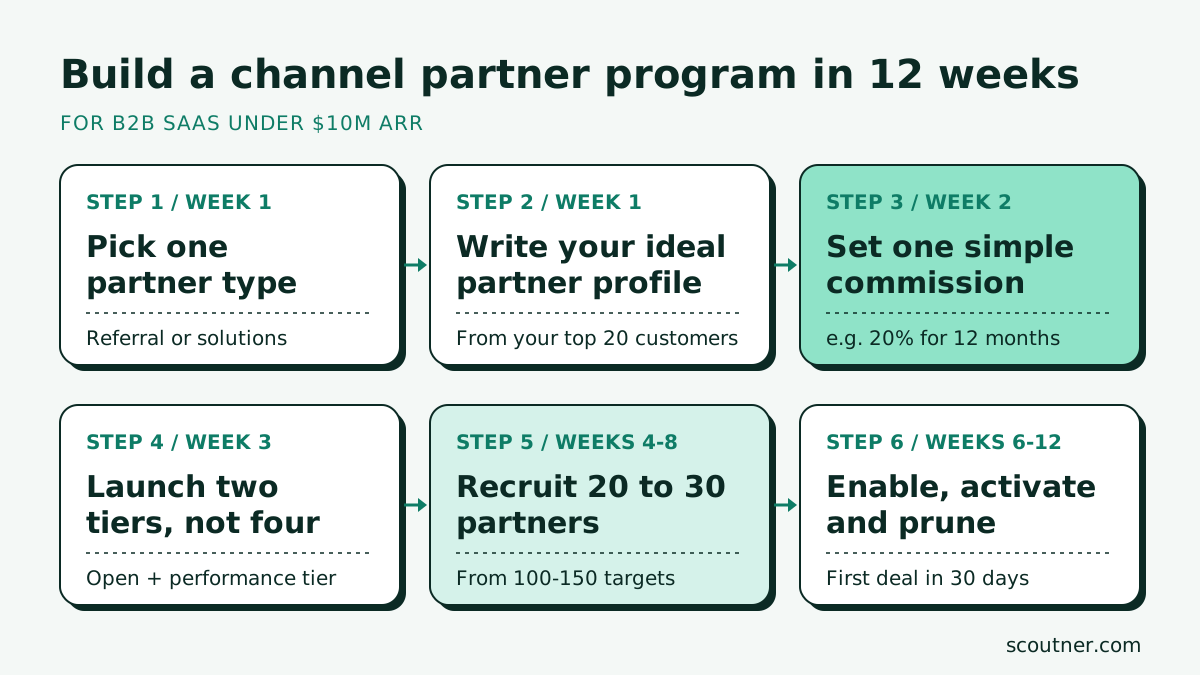
Step 1: Pick one partner type (week 1)
Choose the single partner type that already sits closest to your buyer's purchase decision. For most SaaS under $10M ARR, that is a referral or solutions partner (agency, consultant, implementer), not a reseller. Resellers need margin, pricing control and billing infrastructure you probably do not have yet.
The three types differ mainly in who owns the customer relationship and how you pay:
| Partner type | What they do | How you pay | Real example | Fit under $10M ARR |
|---|---|---|---|---|
| Affiliate / referral | Sends leads or signups via a link | Recurring % of revenue for a fixed period | Pipedrive: 20% for 12 months (entry tier) | High for self-serve, low effort |
| Solutions / implementation partner | Refers, sets up and services clients | Rev share or discount that grows with tier | Gusto: 0% to 20% by client count | Highest for sales-led SaaS |
| Reseller | Buys, bills and supports the customer | Margin on the license | HubSpot Solutions Partners resell and earn commission | Low until you have billing and pricing controls |
Picking one type is the decision most early programs skip. Mixing affiliates and agencies in one program means one commission that is too rich for bloggers or too thin for consultants, and enablement that fits nobody.
Step 2: Write your ideal partner profile (week 1)
An ideal partner profile describes the company most likely to bring you customers: who they serve, what they sell, how many clients they touch and why your product makes them look good. Write it from your best 20 customers backward, not from a list of big brand names you would like to partner with.
Ask each of your top customers one question: "Who did you work with before or while buying us?" The recurring answers (the same CRM consultancy, the same fractional CFO network, the same Shopify agency type) are your profile. Four fields matter most:
- Customer overlap: they serve your ICP, same size, same vertical.
- Motion: they advise on or implement tools in your category.
- Volume: they start 5+ new client engagements a month.
- Incentive: your product makes their service faster, stickier or more profitable.
Our ideal partner profile template walks through the scoring.
Step 3: Set commissions and incentives (week 2)
Set one simple, public commission that a partner can calculate in their head. A recurring 20% of first-year revenue is a proven default for referral partners: Pipedrive pays exactly that at its entry affiliate tier, and Gusto tops out at 20% for its largest accounting partners. Adjust for your gross margin and deal size.
Benchmarks to anchor on:
- The average SaaS affiliate commission is 24.16% (Rewardful, State of SaaS Affiliate Programs, 2026, across 2,847 programs).
- Pipedrive pays 20% for the first 12 months at its Rising Affiliate tier and 30% at Growth, with a 90-day cookie.
- Gusto pays 0% to its Starter partners (1 to 2 clients) and 20% to Gold (50+ clients).
Run the math on your own numbers. A customer paying $500/month at 20% for 12 months earns the partner $1,200. If that feels small next to the hours they spend on a sales-led deal, raise the rate or pay a flat bonus on the first closed deal. More detail on structures in our guides to SaaS partner program commission and SaaS affiliate commission rates.
Good channel partner incentive programs pay beyond cash, too: a directory listing that sends partners leads, early product access, and co-marketing. For a small SaaS, "we send you inbound clients who need implementation" is often worth more than two extra commission points.
Step 4: Design two partner tiers, not four (week 3)
Launch with two tiers: an open entry tier and a performance tier unlocked by a clear, countable threshold (closed customers or revenue). Add a third tier only when at least 10 partners qualify for the top one. Tiers exist to reward the few partners who produce, not to decorate a partner page.
The reason is concentration. TrackRev's Q2 2026 benchmarks show the top 10% of affiliates generate 71% of program revenue. Your tier system should route more money, support and leads to that top decile, and spend almost nothing on the long tail.
A starting structure that works:
- Partner (open): 20% for 12 months, deal registration, sales kit, shared Slack channel.
- Premier (3+ closed customers in 12 months): 25 to 30%, directory listing, named contact, co-marketing.
Use a threshold partners can track themselves. Gusto counts clients (3, 15, 50). HubSpot, a much larger program, now uses points from sourced, assisted and managed revenue, plus a retention floor (80% average GRR) at its Elite tier. You do not need HubSpot's complexity, but copying its idea of tying top tiers to customer retention protects you from partners who push bad-fit deals.
Step 5: Recruit your first 20 to 30 partners (weeks 4 to 8)
Recruit by targeted outreach, not by opening a signup form and waiting. Build a list of 100 to 150 companies that match your ideal partner profile, reach out with a pitch specific to their client base, and aim to sign 20 to 30. Expect only a few to produce in the first quarter.
The math explains why the list must be targeted. Rewardful's 2026 data shows only 7.6% of affiliates ever send a referral and 1.28% generate a sale. An open signup page fills up with the 92% who do nothing. A curated list of partners who already serve your customers flips that ratio.
Where to find them: your customers' answers from Step 2, integration marketplaces in your category, agency directories of the tools your customers use, and LinkedIn searches for consultants who post about your problem space. Scoutner automates this step: paste your URL and Scout scores the partners who already sell to your customers, then drafts the outreach. Either way, follow a documented channel partner recruitment process and size your target with how many partners you need.
What converts in outreach: the specific client overlap ("you implemented X for three companies like our customers"), the money per deal in dollars, and the first lead you can send them.
Step 6: Enable, activate and prune (weeks 6 to 12)
Enablement means getting each new partner to their first referred deal within 30 days. Give them a one-page pitch, a demo account, a deal registration form and a 30-minute kickoff. Then measure activation weekly and cut or re-engage partners who have not registered a deal after 60 days.
Keep enablement small and concrete:
- Kickoff call (30 min): which of their clients fit, today.
- Sales kit: one-pager, 3-minute demo video, pricing sheet, objection answers.
- Deal registration: a simple form so partners trust they will get paid.
- First deal support: join their first call. Nothing activates a partner faster.
Track four numbers from day one: partners signed, partners activated (first registered deal), partner-sourced pipeline and partner-sourced closed revenue. Pipedrive's Solution Partner program asks every partner for "a go-to-market and growth plan" built with its partner manager; at your size, a shared doc with three target accounts does the same job. See partner enablement for the full kit and how to measure partner program ROI for the metrics.
What do real SaaS partner programs look like?
Real SaaS partner programs share three traits: a free entry tier, rewards that scale with a countable metric (clients, revenue or points), and non-cash benefits like directory listings at higher tiers. Gusto, Pipedrive and HubSpot show the pattern at three different sizes, from simple to complex.
| Program | Tiers | How tiers are earned | Economics |
|---|---|---|---|
| Gusto Partner Program (accountants) | Starter, Bronze, Silver, Gold | Clients: 1 to 2, 3 to 14, 15 to 49, 50+ | 0%, 10%, 15%, 20% rev share or client discount |
| Pipedrive Affiliate Program | Rising, Growth, Power | Performance (criteria not published) | 20% or 30% for 12 months, custom at top; 90-day cookie |
| Pipedrive Solution Partners | Authorized, Gold, Platinum | Certifications plus a joint growth plan | Tier-based commission, higher at higher tiers |
| HubSpot Solutions Partner Program | Solutions Partner, Gold, Platinum, Diamond, Elite | Points: Gold 345, Platinum 1,275, Diamond 3,750, Elite 11,000 total | Commission on resold software; Diamond and Elite add 20% on assisted deals of $3,000+ MRR |
Gusto is the best model for a small SaaS: four tiers, one metric (clients), and partners choose whether to keep the rev share or pass it to clients as a discount. That choice matters for advisors who bill their clients directly.
Pipedrive runs two programs side by side, which confirms Step 1: affiliates and solution partners need different economics and different requirements.
HubSpot shows where you end up after a decade: five tiers, point systems and retention floors. Useful as a destination, not a starting point.
What are the channel partner program best practices?
The best practices that matter under $10M ARR: one partner type at launch, a public commission partners can calculate, two tiers with a countable threshold, targeted recruiting from customer overlap, a 30-day first-deal goal, and quarterly pruning. Most failures come from launching too broad, not too small.
- Pay fast and visibly. Partners judge the program by the first payout. Monthly payouts, like Pipedrive's, beat quarterly.
- Make deal registration effortless. A partner who fears channel conflict stops referring.
- Tie top tiers to retention. Reward customers who stay, not just signups.
- Review the partner list every quarter. Double down on the top decile, retire the inactive.
- Keep one owner. A program with no named owner stalls within two months.
- Buy tooling later. A spreadsheet plus a referral tool is enough for the first 30 partners. Compare options like PartnerStack once volume justifies it.
What should you do this week?
This week, write your ideal partner profile from your top 20 customers, pick one partner type and publish a single commission. Next week, build a list of 100 target partners and start outreach. A channel partner program for a SaaS under $10M ARR is a 12-week project with one owner, not an annual initiative.
If you want the list built for you, Scoutner's free scan returns 10 scored partners from your URL, and paid plans (from $299/month, see pricing) run the outreach and activation. Whatever tool you use, the order does not change: type, profile, economics, tiers, recruiting, enablement.
Sources
- Gusto Partner Program: tiers and rewards, Gusto Help Center, 2026
- Gusto Partner Program for Accountants, Gusto, 2026
- Affiliate Partnership Program, Pipedrive, 2026
- Solution Partner Program, Pipedrive, 2026
- Solutions Partner Program Tiers and Benefits 2026, HubSpot, 2026
- State of SaaS Affiliate Programs Report, Rewardful, 2026
- SaaS Affiliate Program Benchmarks, TrackRev, 2026
- The State of Partnerships in GTM 2026, PartnerStack, 2026
- New Report Shows How High-Performing Partner Programs Are Generating Growth in 2025, Bridge Partners and Partnership Leaders, 2025
- Canalys: IT spending to expand 8% in 2025 with increased role for channel partners, Channel Post MEA reporting Canalys, 2024
Related articles