A B2B referral program is the cheapest trust you can buy. Nielsen found that 88% of people trust recommendations from people they know more than any other channel (2021). In SaaS, that trust comes from two very different groups: your customers, and the partners who already sell to your customers. Most programs only tap the first.
This guide covers the difference, a step-by-step setup, what to pay, and real programs with their current published rewards.
What is a B2B referral program?
A B2B referral program is a structured way to reward someone for introducing a business that becomes a paying customer. The referrer makes the intro, you run the sale, and you pay a fixed bounty or a share of revenue once the account converts and pays. It differs from an affiliate program in intent: fewer, warmer introductions instead of traffic.
In SaaS, the referrer is either a customer (a user who likes your product) or a referral partner (an agency, consultant, accountant or complementary vendor who advises your buyers). The mechanics look the same. The economics and the volume do not.
Customer referral vs partner referral: what is the difference?
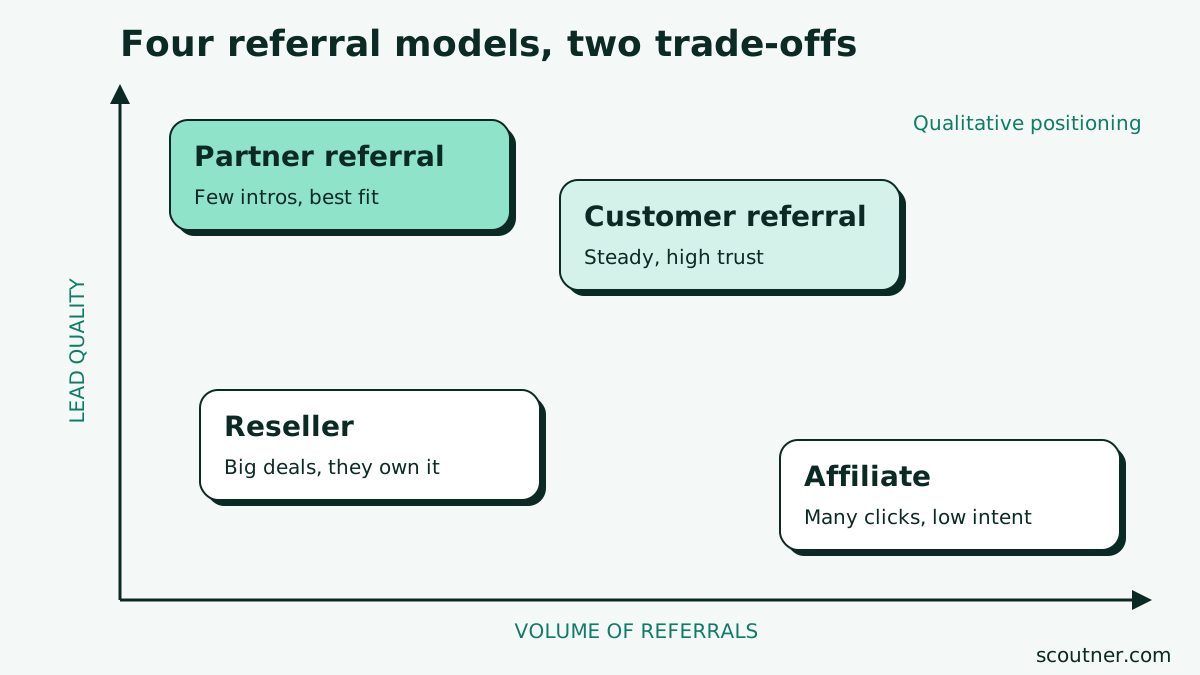
A customer referral program rewards existing users for inviting peers, usually with a small fixed reward like a gift card, credit or extra usage. A partner referral program rewards businesses whose job puts them in front of your buyers, usually with a percentage of first-year revenue. Customers refer occasionally; a good partner refers repeatedly.
That repeat factor is the whole game. A happy customer might refer one or two companies in their lifetime. An accounting firm that advises 200 small businesses, or an agency that implements CRMs every month, can send a steady flow of qualified deals. For the detailed breakdown of partner types, see affiliate vs referral partner vs reseller.
| Model | Who refers | Typical reward | Volume | Lead quality | Tooling |
|---|---|---|---|---|---|
| Customer referral | Existing users and admins | Fixed reward: gift card, account credit, extra usage | Low per referrer, broad base | High: peer to peer trust | In-app referral link, referral software |
| Partner referral | Agencies, consultants, accountants, adjacent SaaS vendors | Share of first-year revenue or a fixed bounty per closed deal | Low to medium, repeatable per partner | Highest: advisor recommends you to a client | Deal registration form, CRM, partner portal or PRM |
| Affiliate | Content creators, review sites, newsletters | Recurring percentage, often 20% to 30% for a limited period | High clicks, few active affiliates | Mixed: many self-serve signups, low intent | Link tracking platform with cookies |
| Reseller | VARs, MSPs, distributors | Margin or discount on your list price | Low, large deals | High, but the reseller owns the customer | PRM, contracts, co-selling process |
Why do B2B SaaS companies need a referral program now?
Buyers are cutting sales reps out of the early journey, so the first recommendation they get carries more weight. Gartner found 67% of B2B buyers prefer a rep-free experience (survey of 646 buyers, published 2026). A referral from a trusted advisor reaches them before your reps can, and arrives with context your cold outreach never has.
Affiliates alone will not fill that gap. Rewardful's 2026 report on 2,847 SaaS affiliate programs found only 7.6% of affiliates generate at least one referral and 1.28% generate at least one sale. Most affiliate signups never act, which is why affiliates rarely make a sale. Referral partners with an existing client base behave differently: they refer because it helps their clients, and the commission is a bonus.
How to set up a B2B referral program in 7 steps
Setting up a referral program takes seven steps: pick who should refer, define a qualified referral, set the reward, choose tracking, write the terms, recruit referrers and review results monthly. The order matters. Most failed programs start with software and a commission rate, then discover nobody on the list has clients to refer.
Step 1: Define your ideal referrer
List the people who talk to your buyer before they buy software like yours. For a payroll tool, that is accountants. For a sales tool, CRM consultants and RevOps agencies. For a dev tool, the vendors your customers already integrate. Write down two or three referrer profiles, with the customer segment each one serves.
Step 2: Define what counts as a qualified referral
Be explicit. A lead that books a demo? An account that signs up? An account that pays? Real programs set the bar at payment: Pipedrive pays once the referred company's combined payments reach $100, and Gusto requires the referred business to run at least one paid payroll. Paying on revenue protects you from low-intent signups.
Step 3: Set the reward
Customers respond to simple, fixed rewards they can explain in one sentence. Partners respond to rewards that scale with deal size. Details on the numbers are in the next section.
Step 4: Choose how you track referrals
Customer programs need a unique link per user, ideally generated inside your app. Partner programs need a deal registration form that timestamps who introduced which account, plus a field in your CRM. If you already run affiliates on a link tracker, compare options in our Rewardful review.
Step 5: Write short terms
Cover attribution (first registered intro wins, and for how long), payout timing, clawbacks on refunds, self-referral rules and eligible plans. Notion, for example, reverses affiliate rewards if the user downgrades or is refunded within the first two months.
Step 6: Recruit referrers actively
A launch email to customers gets you customer referrals. It does not get you partners. Partners have to be found and pitched one by one, starting with firms that already serve your customers.
Step 7: Review monthly and prune
Track referrals, win rate and revenue per referrer. Expect a small group of referrers to drive most results, and spend your time enabling them.
How much should a referral fee be?
A B2B referral fee is usually either a fixed bounty per paying account or a percentage of first-year revenue. Most published SaaS programs pay 20% to 30% of first-year revenue to partners and affiliates, with customer rewards between $100 and $1,000 per paying account. The Rewardful 2026 average affiliate commission is 24.16%.
Use three checks to set yours:
- Compare it to your CAC. A referral fee is a customer acquisition cost paid only on success. If a paid-ads customer costs you more than 30% of first-year revenue, a 20% referral fee is cheap.
- Match the reward to the effort. A customer sharing a link does little work, so a fixed reward works. A partner who qualifies the deal, joins the call and handles objections has earned a revenue share.
- Cap the duration. Most published programs pay on year one, not for life. HubSpot pays 30% recurring for up to one year; Notion pays 20% of year-one revenue.
For deeper benchmarks by partner type, read SaaS partner program commission and SaaS affiliate commission rates.
What are real B2B SaaS referral program examples?
Gusto, Pipedrive and Dropbox run customer referral programs with fixed rewards, while HubSpot, Notion and monday.com run partner and affiliate programs paid as a share of first-year revenue. All figures below were checked on each company's official page in September 2026. Rewards change often, so verify before you benchmark.
| Company | Who can refer | Reward | Source |
|---|---|---|---|
| Gusto | Customers | Referrer: $300 for the 1st referral, rising to $400, $500, $700, then $1,000 from the 5th. Referred business: $100 Visa gift card. Requires a paid payroll; paid within 30 days of the first paid invoice. | Gusto, 2026 |
| Pipedrive | Customers | Referrer: 100 gift card in their currency, via Amazon or PayPal, once the referred company pays $100. Referred company: 30-day free trial. | Pipedrive, 2026 |
| Dropbox | Users | 500 MB of extra space per referral on Basic (up to 16 GB), 1 GB on Plus, Family and Professional (up to 32 GB). The referred friend also gets bonus space. | Dropbox Help |
| HubSpot | Affiliates and creators | 30% recurring commission for up to one year, 180-day cookie window. | HubSpot, 2026 |
| Notion | Affiliates | Up to $50 per activated signup plus 20% of year-one revenue, on workspaces that upgrade within 180 days. | Notion, 2026 |
| monday.com | Affiliates | Up to 100% commission on the first year of sales of each referred customer. | monday.com, 2026 |
Three patterns stand out:
- Fixed rewards for customers, revenue share for partners. Gusto and Pipedrive pay flat amounts. HubSpot and Notion pay a percentage.
- Double-sided rewards. Gusto, Pipedrive and Dropbox all give the referred company something too, which makes the referrer's ask easier.
- Escalating rewards for repeat referrers. Gusto's tiers pay more from the second referral onward. It is a nudge toward partner behavior: rewarding the few who refer again and again.
Dropbox is the historical reference for double-sided rewards, but storage is a consumer-style reward. In B2B, the equivalent is account credit or a longer trial, as Pipedrive does.
How do you find referral partners beyond your customer base?
Look for businesses that already sell to your ideal customer but do not compete with you: agencies, consultants, implementers, accountants and complementary SaaS tools. Search for firms listed in the partner directories of tools your customers use, then pitch each one with a specific reason their clients benefit from your product.
A practical way to build the list:
- Start from your best customers. Ask who set up their stack, who advises them and which tools they use alongside yours.
- Mine partner directories. HubSpot, Salesforce, Shopify and most large platforms publish agency and consultant directories filtered by region and specialty.
- Score before you pitch. Rank each firm on client overlap, service fit and activity. Ten well-matched partners beat a hundred random signups.
- Pitch the client outcome, not the commission. Partners refer when you make them look good to their clients.
This recruiting step is where most teams stall, because it is manual research. Scoutner automates it: paste your URL and Scout returns scored partners who already sell to your customers, then drafts the pitch. For more ways to source partners, see how to find affiliates and how to build a channel partner program.
What mistakes kill B2B referral programs?
Most B2B referral programs fail from neglect, not bad design. The common mistakes are launching with only customers as referrers, rewards too small to justify effort, vague attribution rules, slow payouts and no one owning partner recruitment. Fix ownership first: name one person accountable for recruiting and activating referrers.
- Counting signups instead of active referrers. Rewardful's data shows how few affiliates ever send a referral. Measure active referrers, not program size.
- Paying on signup. Pay on revenue, as Gusto and Pipedrive do.
- Slow or unclear payouts. State when you pay, then pay on time. Gusto commits to paying within 30 days of the first paid invoice.
- Treating partners like affiliates. A partner who brings a five-figure deal expects a named contact, deal status updates and co-selling help, not just a dashboard.
Start with one referrer profile, one clear reward and ten recruited partners. When you are ready to find them at scale, see Scoutner pricing.
Sources
- Beyond martech: building trust with consumers, Nielsen (2021)
- Gartner Sales Survey Finds 67% of B2B Buyers Prefer a Rep-Free Experience, Gartner (2026)
- State of SaaS Affiliate Programs Report, Rewardful (2026)
- Referral Rewards Terms, Gusto (2026)
- Pipedrive Referral Program Terms and Conditions, Pipedrive (2026)
- How much free referral space can I earn?, Dropbox Help (2026)
- HubSpot Affiliate Program, HubSpot (2026)
- Notion Affiliate Program, Notion (2026)
- monday.com Affiliate Program, monday.com (2026)
Related articles