
Most SaaS partner programs start with a sign-up page and hope the right people find it. Then the dashboard fills with affiliates who never send a referral, and the team concludes that partners do not work for its product.
An ideal partner profile fixes the step before recruiting. It is a one-page description of the partner you want, written precisely enough that two people on your team would pick the same firms from a list of fifty. This guide gives you the template (fillable online, or as a printable scorecard), shows how to fill it from your own customer data, and looks at how three well-known programs, Gusto, Ramp and Klaviyo, describe the partners they recruit.
- An ideal partner profile (IPP) describes the partners most likely to sell your product. It is the partner-side twin of your ideal customer profile (ICP).
- Build it from your best customers: list the firms they already pay for advice or services, then describe what those firms have in common.
- Write one IPP per partner type. An accounting firm and a content creator need different criteria, pitches and rewards.
- Of 341 SaaS partner programs in our directory, 69% are affiliate programs, yet many B2B buyers choose software on the advice of an accountant, agency or consultant.
- Only 7.6% of SaaS affiliates ever generate a referral (Rewardful, 2026). A sharp IPP is how you recruit fewer partners who actually sell.
What is an ideal partner profile?
An ideal partner profile (IPP) is a short written description of the type of company that would benefit most from your partner program and bring you the most customers. It covers who the partner serves, what it already sells or implements, its size and location, how it earns money, and the signals that predict an active partner.
Channeltivity, a partner relationship management vendor, defines it as "a detailed description of a partner that would benefit most from participating in your partner program" and compares it to an ideal customer profile. Kiflo, another partner software vendor, puts the core rule in one line: "Partners must reach the same or complementary ICP."
That last point is what most profiles miss. An IPP is not a list of nice-to-have traits such as "well known" or "large audience". It starts from your buyers and works backward to the people those buyers already listen to.
How is an IPP different from an ICP?
Your ICP describes the companies that buy your product. Your IPP describes the companies that sell to, advise or serve those buyers. The ICP answers "who pays us?"; the IPP answers "who do they already trust with this decision?" You need the ICP first, because every IPP criterion is checked against it.
| Ideal customer profile (ICP) | Ideal partner profile (IPP) | |
|---|---|---|
| Describes | The companies that buy your product | The firms that serve, advise or sell to those companies |
| Key question | Who gets the most value and pays? | Who already influences that purchase? |
| Main criteria | Industry, size, tech stack, pain | Client base, services, influence on the purchase, business model |
| Main signal | Usage, retention, expansion | Named clients that match your ICP, published work |
| How many | One or two per product | One per partner type you recruit |
| Used for | Sales targeting and marketing | Partner sourcing, scoring and pitch |
A practical test: if you swapped your ICP for a competitor's, would your IPP change? If not, your IPP is too generic.
Which fields should an ideal partner profile template include?
A useful IPP fits on one page and has eight fields: the partner type, the clients they serve, why they fit, what they already deliver, firmographics, signals of an active partner, disqualifiers, and what they earn from you. Add a target for the next 90 days so the profile drives action, not just alignment.
- Partner type. One type per profile: accounting firms, HubSpot agencies, IT managed service providers, newsletter writers. "Agencies" alone is too broad.
- Who they serve. Your ICP, seen from the partner's side: company size, industry, the role the partner works with (CFO, head of marketing, HR lead).
- Why they fit. One sentence on the moment where your product helps their work. For example: "They set up payroll for new clients and get blamed when it breaks."
- What they already deliver. Services and tools. A firm that already implements an adjacent product is easier to activate than one that would need a new practice.
- Firmographics. Team size, location, number of active clients in your ICP.
- Signals of an active partner. Named client case studies, listings in other vendors' partner directories, content that already recommends tools in your category.
- Disqualifiers. Sells a competing product, fewer than a handful of clients in your ICP, no public proof of work.
- What they get. Revenue share or referral bonus, but also the value for their clients and the services revenue your product creates for them.
You can fill these fields online in our free ideal partner profile template and download the result as a Word or Markdown file. If you prefer paper, the printable IPP scorecard is a single HTML file that adds up scores as you type and prints on one page.
How do you build an ideal partner profile from your customers?
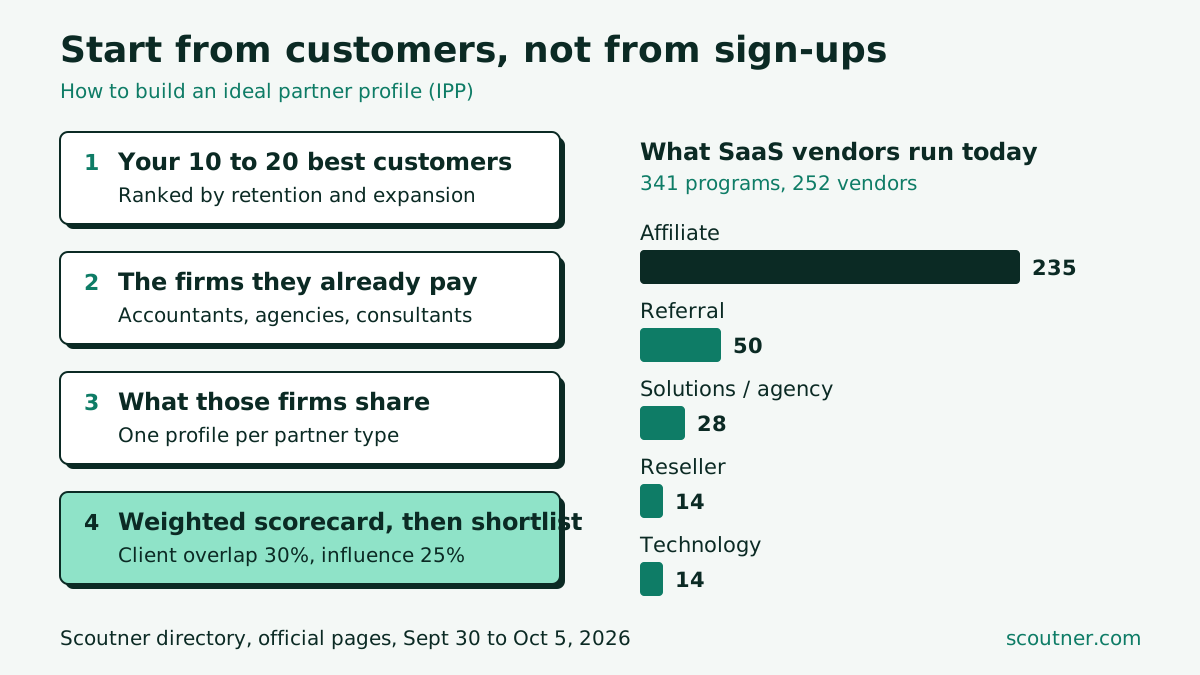
Start from your 10 to 20 best customers, not from partner directories. For each, write down which outside firms they already pay for advice or services in your area: accountant, agency, consultant, implementer. The partner types that come up most often, and the traits they share, are your IPP. Then check it against your existing partners.
Step 1: pick your best customers. Use retention and expansion, not logo size. If you already have a few partners, also look at which ones sent your best deals. Channeltivity suggests starting from the partners behind "the most lucrative referrals".
Step 2: list who they already pay. Ask in customer calls ("who helped you choose and set up your current tools?"), read case studies, check the "built by" or "managed by" footers on their sites. You are looking for firms that sit next to the buying decision.
Step 3: group by partner type. You will usually see two or three clusters, for example bookkeeping firms, fractional CFOs and finance software consultants. Keep the cluster that appears most often and has the most influence on the purchase. Write your first IPP for that cluster only.
Step 4: describe what the cluster shares. Team size, client count, the services they list, the tools they already implement, the directories where they appear. Channeltivity's questions are a good checklist: where they are based, whether they are B2B or B2C, how big they are, and "what other partner programs are they a part of?"
Step 5: add disqualifiers and test the filter. Track360, an affiliate software vendor, offers a useful rule of thumb: "If your criteria would qualify 80% of applicants, your profile is not filtering effectively." Run your profile against 30 firms you know. If almost all pass, tighten it.
Why does the partner type matter so much?
Because the type decides how a partner earns money from you, and that decides whether they act. An accountant earns from managing a client's books, an agency from implementation fees, a content creator from commissions. A program designed for one type rarely motivates the others, which is why each type needs its own profile, pitch and reward.
The default choice in SaaS is the affiliate. In our directory of 252 SaaS vendors, verified on their official pages between September 30 and October 5, 2026, 235 of 341 programs (69%) are affiliate programs. Only 50 are referral programs, 28 are solutions or agency programs, 14 reseller programs and 14 technology partner programs. That imbalance matters more now that features are cheap to clone: the accountants, agencies and integrators around a product are what vibe coding can't replace.
Affiliate programs suit products bought by individuals after reading a review. For many B2B products, the buyer asks an advisor first, and the profile should say so. The cost of picking the wrong type shows in activation data: across 2,847 active SaaS affiliate programs, Rewardful found that 7.6% of affiliates generate at least one referral and 1.28% at least one sale, and that 56% of programs have fewer than 50 affiliates. With programs that small, recruiting the right type matters more than recruiting more.
How do Gusto, Ramp and Klaviyo define their ideal partners?
None of the three publishes a document called an IPP, but their official partner pages show one. Gusto recruits accounting firms that run payroll for clients and rewards them by clients managed. Ramp targets CPA and accounting firms and sells them an advisory practice. Klaviyo targets agencies and leads with the services revenue they earn around its product.
Klaviyo describes its partner network as "leading agencies, consultants, and technology providers", with separate paths for agency and solution partners and for technology partners. Its main argument to agencies is a services figure, not a commission rate: on average, for every $1 in Klaviyo MRR, partners report at least $3 in implementation, strategy and managed services. If your IPP is a service firm, find your own version of that number.
Ramp and Gusto both appear in our directory with their full terms: Ramp and Gusto.
How do you turn an IPP into a partner scorecard?
Turn each IPP field into a scored criterion, weight the ones that predict sales, and score every candidate before outreach. Client overlap and influence on the purchase should carry the most weight, because they decide whether the partner can sell at all. Activity signals come next, then capacity and commercial fit.
The printable scorecard uses these weights, which you should adjust to your own data:
| Criterion | Weight | Score 1 (weak) | Score 5 (strong) | Where to check |
|---|---|---|---|---|
| Client overlap with your ICP | 30% | Different industry or size | Many named clients that match your ICP | Case studies, directory profiles |
| Influence on the purchase | 25% | Not involved in tool choices | Chooses or implements the stack for clients | Service pages, client interviews |
| Fit with what they deliver | 15% | Unrelated to their services | Your product is part of a service they sell | Service pages, certifications |
| Activity signals | 15% | No public work | Recent case studies, listed in other vendor directories | Website, partner directories |
| Capacity | 10% | Solo, no growth signs | Growing team with a client practice | LinkedIn headcount, job posts |
| Commercial fit | 5% | Business model conflicts with your offer | Your reward fits how they earn | Pricing page, conversation |
A weighted score of 4 or more out of 5 earns a personal pitch. Between 3 and 4, add the firm to a nurture list. Below 3, skip it. Firms that pass a hard disqualifier, such as selling a competing product, are out whatever their score. For the next step, see how to find channel partners, which covers where firms that match your profile list themselves, and how many partners you need.
What mistakes make an ideal partner profile useless?
The common mistakes are writing one profile for every partner type, describing partners by fame instead of client overlap, copying a competitor's program without checking who their partners serve, and never updating the profile after the first referrals come in. Review it each quarter against the partners who actually sent deals.
- One profile for everyone. An IPP that covers "agencies, consultants, affiliates and resellers" filters nothing.
- Audience size over client fit. A newsletter with 100,000 readers outside your ICP is worth less than a ten-person firm with 40 clients inside it.
- No disqualifiers. Without them, every applicant looks like a maybe and the team spends time on the wrong calls.
- No owner and no review. Assign the profile to one person and compare it every quarter with your top five partners by revenue.
Frequently asked questions
What is an ideal partner profile?
An ideal partner profile (IPP) is a one-page description of the partners most likely to sell your product: the clients they serve, what they already deliver, their size and location, how they earn money, the signals of an active partner and the disqualifiers. It is the partner equivalent of an ideal customer profile.
What is the difference between an IPP and an ICP?
Your ICP describes the companies that buy your product. Your IPP describes the firms that serve, advise or sell to those companies, such as accountants, agencies, consultants or resellers. Every IPP criterion should be checked against your ICP.
How many ideal partner profiles should a SaaS company have?
One per partner type you recruit. Start with the type that appears most often next to your best customers, for example accounting firms or marketing agencies, and add a second profile only when the first one produces active partners.
What should an ideal partner profile template include?
Eight fields: partner type, who they serve, why they fit, what they already deliver, firmographics, signals of an active partner, disqualifiers, and what they earn from you. Add a 90-day target: partners to contact, to sign and to bring to a first referral.
Is there a free ideal partner profile template?
Yes. Scoutner offers a free fillable ideal partner profile template that downloads as a Word or Markdown file, and a printable one-page scorecard in HTML that adds up weighted scores for each candidate partner.
Scoutner is an AI partner recruitment platform for B2B SaaS. It drafts your ideal partner profile from your website and finds the agencies, consultants and creators that already serve your customers.
Sources
- Ideal Partner Profile (IPP): Everything you need to know, Channeltivity, July 17, 2024
- Template: Build Your Ideal Partner Persona, Kiflo, Checked October 12, 2026
- Defining Ideal Partner Profiles, Track360, Checked October 12, 2026
- State of SaaS Affiliate Programs Report, 2026 Edition, Rewardful, Updated July 21, 2026
- Gusto Affiliate Program, Gusto, Checked October 12, 2026
- Gusto Partner Program, Gusto Help Center, Checked October 12, 2026
- Accounting partnerships, Ramp, Checked October 12, 2026
- Klaviyo Partners, Klaviyo, Updated June 16, 2026
- SaaS Partner Program Benchmarks 2026, Scoutner, October 7, 2026
Related articles
For SaaS founders
Building your partner channel? See which agencies could sell your SaaSPaste your website. Scout scores 10 partners (agencies, consultants, resellers) who already sell to your buyers, with decision-makers. Free. Shopify
 Moz
 Semrush
 HubSpot
 ClickUp
 Notion
 Airtable
 ClickFunnels
 HeyGen
 Fiverr
 Kinsta
 Squarespace
 systeme.io
 Teachable
 Thinkific
 Xero
 Framer
 HighLevel
 n8n
 QuickBooks
 1Password
 Adobe
 Bluehost
 Hostinger
 Lovable
 Mailchimp
 monday.com
 Skool
 ElevenLabs
 Grammarly
 Surfer
 Upwork
 Gusto
 Rippling
 ActiveCampaign
 Apollo.io
 Attio
 AWeber
 BambooHR
 beehiiv
 Bench
 Brevo
 Buffer
 Close
 Cloudways
 Deel
 Descript
 DreamHost
 Elementor
 folk
 Frase
 FreshBooks
 Freshworks
 GetResponse
 Hootsuite
 Instantly
 invideo
 Jotform
 Kajabi
 Keap
 Kit
 Kittl
 Later
 LearnWorlds
 lemlist
 Lusha
 MailerLite
 Make
 Mangools
 Metricool
 Miro
 Murf AI
 Namecheap
 NordPass
 OnPay
 Originality.ai
 Pabbly
 Piktochart
 Pipedrive
 Podia
 Proton
 Reply.io
 Riverside
 Rytr
 SE Ranking
 SiteGround
 Smartlead
 SocialBee
 Softr
 Sprout Social
 Synthesia
 Tally
 ThriveCart
 Typeform
 VEED
 Visme
 Webflow
 Woodpecker
 WP Engine
 Writesonic
 Zoho