
Every week in 2026 brings a new version of the same claim: AI made code cheap, so anyone can build the software they used to rent, so SaaS is finished. Founders share the internal tools that replaced their subscriptions. Investors ask which categories will be "vibe coded" away next.
Part of it is true. The cost of producing software has collapsed, and a lot of simple, high-margin tools are exposed. But the debate mostly looks at one side of a B2B purchase: the product. It skips the people around the product, the accountant who picks the payroll tool, the agency that runs the email platform, the IT provider that installs the security stack. That layer is the part a weekend clone does not come with. This article looks at what vibe coding can copy, what it cannot, and who still buys software instead of building it.
- Vibe coding lowers the cost of copying features, not the cost of being trusted. A clone ships without the advisors, implementers and contracts around the original.
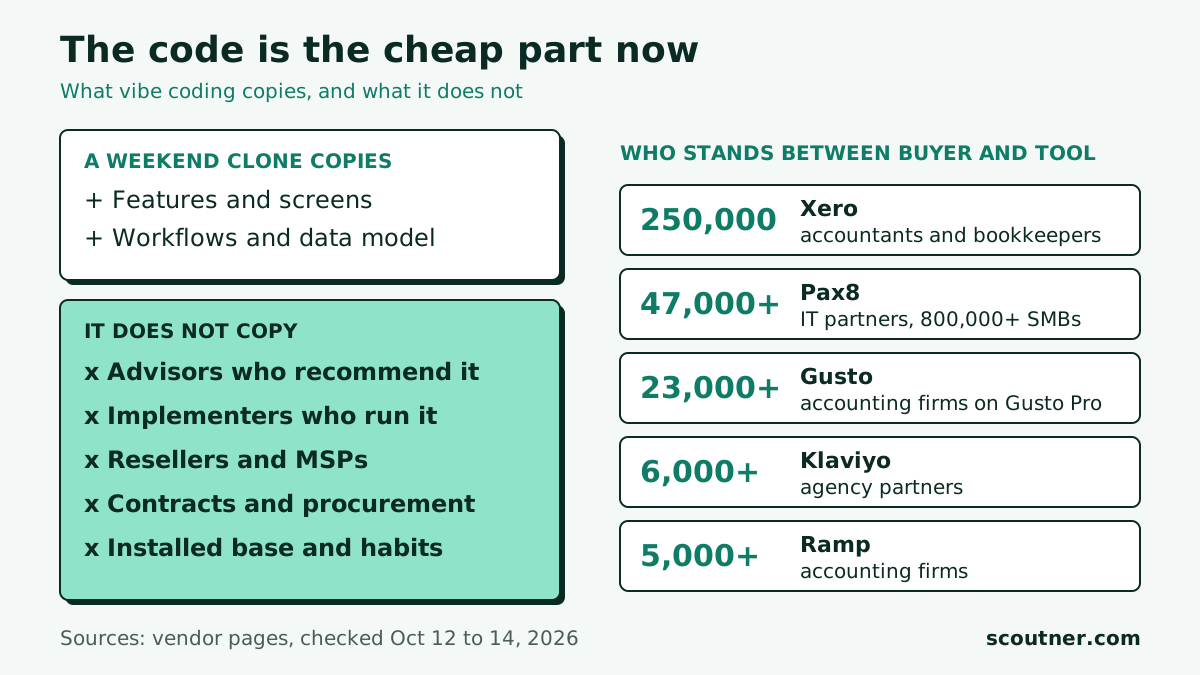
- Many B2B buyers do not pick software alone. Xero says 250,000 accountants and bookkeepers use it in their practice; Pax8 says 47,000+ IT partners serve more than 800,000 small businesses.
- Partners earn from the tools they recommend. Klaviyo says its partners report at least $3 of services for every $1 of Klaviyo revenue, which gives them a reason to keep clients on it.
- Most SaaS programs are not built for this layer: of 341 programs in our directory, only 28 target agencies or solutions partners, against 235 affiliate programs.
- The defense against "build your own" is to sell through the people your buyers already pay, starting with an ideal partner profile and a short list of firms.
Is SaaS dead because of vibe coding?
No. Vibe coding makes it cheap to rebuild a product's features, which hurts tools whose only advantage was the code. It does not rebuild the distribution, trust and services around a product. B2B software that is chosen, set up and run by an outside advisor or implementer is much harder to replace than software a single user bought with a credit card.
The useful question is not "can this be cloned?" Almost anything with a web interface can now be roughly cloned. The question is "who would have to change their habits if the customer switched?" If the answer is only the customer, the product is exposed. If the answer includes the customer's accountant, agency or IT provider, the product sits inside a web of relationships that a clone does not inherit.
What can a weekend clone actually copy?
A clone can copy screens, workflows, data models and most integrations exposed by public APIs. In August 2026, Latent Space ran a public hackathon offering $10,000 to whoever could clone, in one weekend, an enterprise tool its team was about to pay more than $40,000 a year for. The stated goal was to find what is still hard to kill.
The event page, hosted by swyx, put the rules in a few lines: clone the SaaS in a weekend, the team evaluates it as the prospective customer, all code is open sourced, and the winner gets $10,000. The organizers framed it as a series: they plan to keep going "with increasingly ambitious saas things for SMBs until we find the boundary of what saas is still hard to kill in a weekend."
That framing is the honest version of the debate. Nobody serious claims every SaaS can be cloned; the experiment is about finding the line. And a weekend contest only tests one side of it. The judges evaluate the product. They do not test whether the clone comes with an implementation partner, a support contract, an accountant who already knows it, or a reseller who bundles it with the rest of a client's stack. Those are exactly the things that keep a mid-sized company on a tool after the features stop being special.
What can't vibe coding replace in B2B?
It cannot replace the relationship layer: the advisors who recommend a tool, the implementers who configure it, the service providers who run it for clients, and the contracts and procurement steps that bind a company to a vendor. These are people and agreements, not code, and they build up over years.
| Layer | What a clone copies | What it does not copy | Real example |
|---|---|---|---|
| Product | Features, UI, data model | Years of edge cases and support history | Latent Space "Kill My SaaS" contest, Aug 2026 |
| Advisors | Nothing | The accountant or consultant who recommends the tool | Xero: 250,000 accountants and bookkeepers |
| Implementers | Nothing | The agency or integrator that configures and runs it | Klaviyo: 6,000+ agency partners |
| Resellers and MSPs | Nothing | The IT provider who bundles and bills it | Pax8: 47,000+ partners, 800,000+ SMBs |
| Contracts | Nothing | Procurement approval, security review, multi-year terms | Typical for mid-market and enterprise buyers |
| Installed base | Nothing | Data, habits and trained staff at every client | Gusto: 23,000+ accounting firms on Gusto Pro |
The first row is the only one AI made cheaper. The other five rows are why a client does not switch even when an equivalent tool exists, and often even when a cheaper one does.
Who still buys SaaS instead of building it?
Process-driven companies: businesses with an accountant, an IT provider or an agency, a finance team that wants contracts, and staff who need training more than custom features. They buy software through advisors and service providers, and they rarely build their own, because nobody on the team wants to own and maintain it.
Several large vendors publish how much of their market reaches them this way.
- Xero says 250,000 accountants and bookkeepers use it in their practice. Its FY26 annual report puts it simply: "Some customers work directly with us, while others use Xero through their accountant or bookkeeper." A small business that uses Xero because its bookkeeper does is not going to vibe code a ledger.
- Gusto says more than 23,000 accounting firms use Gusto Pro to manage client payroll from one dashboard (internal data as of April 30, 2026). Its partner tiers count clients whose payroll the firm manages, not clients the firm only refers.
- Pax8, a cloud marketplace for IT service providers, says it is trusted by 47,000+ partners serving more than 800,000 small and mid-sized businesses. Those businesses get their software stack from their managed service provider, often on one bill.
- Ramp says 5,000+ accounting firms have joined its partner program and that 92 of the top 100 CPA firms manage clients on Ramp.
In each case the buyer's decision runs through someone else. To replace the tool, a challenger has to convince the advisor, not just the end user. A cheaper clone does not change the advisor's incentive, and often it changes nothing at all for them.
Why are SaaS companies launching programs for agencies now?
Because the relationship layer is where they can still differentiate. When features are easy to copy, vendors invest in the partners who deploy their product inside companies. Replit, one of the best-known vibe coding platforms, launched a Solutions Partner Program for systems integrators, consultancies and agencies on October 13, 2026.
What these programs pay, and what agencies get besides commission, is covered in our guide to agency partner programs. Most SaaS vendors have not built this. In our directory of 252 SaaS vendors, verified on official pages between September 30 and October 5, 2026, 235 of 341 partner programs (69%) are affiliate programs and only 28 are solutions or agency programs. Affiliates matter, but they are the layer easiest to lose: Rewardful's 2026 report finds that only 7.6% of SaaS affiliates ever send a referral.
Can a partner channel be a moat?
Distribution alone is not a moat; a competitor can copy a sign-up page and a commission rate. Partners become a moat when they create switching costs: when the agency has trained staff, built processes and a services business around your product, and the client's data and habits live in it. Then switching means changing providers, not just tools.
This is the distinction that matters for small SaaS companies. An affiliate who posts a review is a channel. An accounting firm that runs dozens of clients' payroll in your product, or an agency whose retainer depends on your platform, is part of your product's switching cost. Gusto's tiers reward the second kind on purpose, by counting only clients the firm actually manages.
Three questions tell you whether your partner channel protects you:
- Do partners earn money from running your product, not only from selling it? Services revenue keeps them engaged after the first sale.
- Would a client need a new provider to leave you? If the partner would have to retrain staff or migrate many clients, the cost of switching is shared, and it is high.
- Are partners certified or trained on your product? Training is an investment they do not want to waste, which is why HubSpot, Webflow and now Replit certify partners.
How do you build the relationship layer for your SaaS?
Start from your best customers and find the firms they already pay: accountants, agencies, consultants, IT providers, integrators. Pick one partner type, write an ideal partner profile, recruit 10 to 20 firms that already serve your buyers, and give them a reason to earn from running your product, not only from referring it.
- List who your customers already trust. For your 10 to 20 best accounts, note the outside firms involved in choosing or running tools like yours. Our guide on how to find channel partners shows how to source them.
- Write one profile per partner type. Use the ideal partner profile template: who they serve, what they deliver, how they earn money, which signals predict an active partner.
- Design the economics around services. Revenue share and referral fees matter, but so do the services your product creates for the partner: setup, migration, reporting, managed operations.
- Make the first 90 days easy. Certification, a demo account and a short list of their own clients who fit. The partner enablement plan covers this step by step.
- Measure partner-managed customers separately. Track how many customers a partner runs, not only how many it referred. That number is your relationship layer.
What does this mean if you are a small SaaS?
It means the "build your own" wave is a sorting mechanism. Tools sold one user at a time, with no one around them, will feel it first. Tools embedded in the work of accountants, agencies and integrators will feel it last. A small SaaS can move from the first group to the second by choosing partners deliberately, years before a clone shows up.
You do not need hundreds of partners. You need the few firms whose clients look like your best customers and who can earn from running your product. If you are not sure what kinds of firms those are, start with what a channel partner is and the differences between affiliates, referral partners and resellers.
Frequently asked questions
Is SaaS dead because of AI and vibe coding?
No. Vibe coding makes features cheap to copy, which threatens simple tools sold one user at a time. B2B software chosen, configured and run by accountants, agencies, MSPs or integrators is much harder to replace, because a clone does not come with those relationships, contracts or trained staff.
What can vibe coding not replace?
The relationship layer around B2B software: advisors who recommend it, implementers who configure it, service providers who run it for clients, procurement contracts, and the installed base of data and trained users. These are people and agreements, not code.
Which SaaS products are most at risk from build-your-own?
Products whose only advantage is their features, bought by a single user with a card, with no partner, integration or service business around them. If nobody outside the customer would notice a switch, the product is exposed.
How do partners create switching costs for SaaS?
When partners earn services revenue from running a product, train their staff on it and manage many clients in it, leaving the product means changing providers too. Klaviyo says partners report at least $3 of services for every $1 of Klaviyo MRR.
How many SaaS partner programs target agencies or integrators?
Few. In the Scoutner directory of 252 SaaS vendors verified in October 2026, 28 of 341 partner programs were solutions or agency programs, against 235 affiliate programs.
Scoutner is an AI partner recruitment platform for B2B SaaS. It finds the agencies, accountants, consultants and integrators that already serve your customers, so you can build your partner channel from the firms your buyers trust.
Sources
- Kill My SaaS 1: $10,000 to kill my SaaS, Latent Space (event page), August 2026, checked October 14, 2026
- Introducing Replit Solutions Partners, Replit, October 13, 2026
- Xero partner program, Xero, Checked October 14, 2026
- FY26 Annual Report, Xero, May 14, 2026
- Gusto for accountants, Gusto, Data as of April 30, 2026, checked October 14, 2026
- Pax8 Marketplace, Pax8, Updated September 9, 2026
- Accounting partnerships, Ramp, Checked October 12, 2026
- Klaviyo Partners, Klaviyo, Updated June 16, 2026
- State of SaaS Affiliate Programs Report, 2026 Edition, Rewardful, Updated July 21, 2026
- SaaS Partner Program Benchmarks 2026, Scoutner, October 7, 2026
Related articles
For SaaS founders
Building your partner channel? See which agencies could sell your SaaSPaste your website. Scout scores 10 partners (agencies, consultants, resellers) who already sell to your buyers, with decision-makers. Free. Shopify
 Moz
 Semrush
 HubSpot
 ClickUp
 Notion
 Airtable
 ClickFunnels
 HeyGen
 Fiverr
 Kinsta
 Squarespace
 systeme.io
 Teachable
 Thinkific
 Xero
 Framer
 HighLevel
 n8n
 QuickBooks
 1Password
 Adobe
 Bluehost
 Hostinger
 Lovable
 Mailchimp
 monday.com
 Skool
 ElevenLabs
 Grammarly
 Surfer
 Upwork
 Gusto
 Rippling
 ActiveCampaign
 Apollo.io
 Attio
 AWeber
 BambooHR
 beehiiv
 Bench
 Brevo
 Buffer
 Close
 Cloudways
 Deel
 Descript
 DreamHost
 Elementor
 folk
 Frase
 FreshBooks
 Freshworks
 GetResponse
 Hootsuite
 Instantly
 invideo
 Jotform
 Kajabi
 Keap
 Kit
 Kittl
 Later
 LearnWorlds
 lemlist
 Lusha
 MailerLite
 Make
 Mangools
 Metricool
 Miro
 Murf AI
 Namecheap
 NordPass
 OnPay
 Originality.ai
 Pabbly
 Piktochart
 Pipedrive
 Podia
 Proton
 Reply.io
 Riverside
 Rytr
 SE Ranking
 SiteGround
 Smartlead
 SocialBee
 Softr
 Sprout Social
 Synthesia
 Tally
 ThriveCart
 Typeform
 VEED
 Visme
 Webflow
 Woodpecker
 WP Engine
 Writesonic
 Zoho