
On October 13, 2026, Replit launched a Solutions Partner Program for systems integrators, consultancies and agencies. A few days earlier, the same question kept coming up among SaaS founders: if software is getting cheaper to build, where does the next dollar of budget come from? For a growing number of vendors, the answer is the agencies that already sit next to the buyer.
This guide explains what an agency partner program is, why SaaS companies are launching them instead of (or next to) affiliate programs, what the best-known programs actually pay according to their own pages, and how to design one that agencies use. Every figure comes from an official vendor page or from our directory of 255 SaaS vendors, verified on official pages between September 30 and October 5, 2026.
- An agency partner program rewards firms that implement and run your product for clients, not people who only post a link.
- Agencies sell services on top of software. Klaviyo says partners report at least $3 of services for every $1 of Klaviyo MRR; HubSpot puts client services spend at $10k to $500k a year.
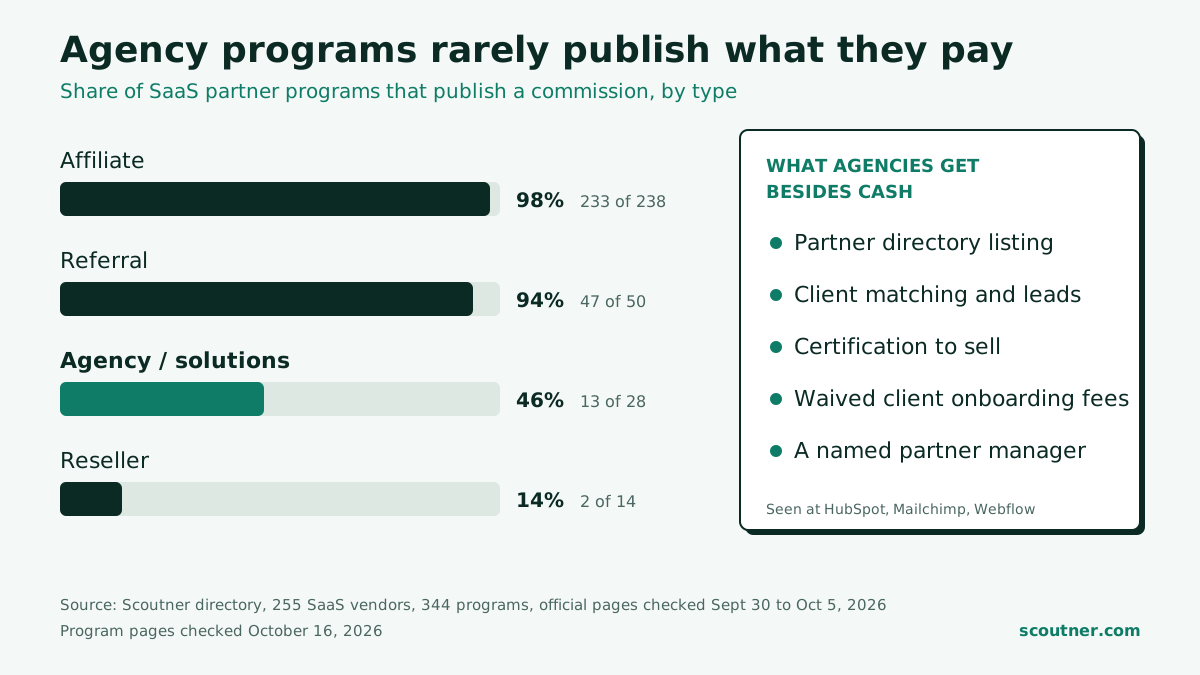
- Agency programs are rarer and less transparent than affiliate programs: in our directory, 28 of 344 programs target agencies or solutions partners, and only 13 of those 28 publish a commission.
- The best programs pay for managed customers, not only referrals. Mailchimp pays 5% of managed client revenue next to its 25% referral rate.
- Directory listings, client matching and certification often matter more to agencies than the commission rate.
What is an agency partner program?
An agency partner program is a partner program for service firms (marketing agencies, web studios, consultancies, systems integrators) that sell, implement or manage a SaaS product for their clients. In exchange, the vendor offers revenue share, certification, a listing in its partner directory and help winning clients. The agency is paid to run the tool, not only to mention it.
That last point is what separates it from an affiliate program. An affiliate publishes content and earns when a reader buys. An agency partner configures the account, migrates data, trains the client's staff and often logs in every week to run campaigns or workflows. The vendor gets a customer who is set up properly and supported by someone the client already pays.
Vendors use different names for the same idea: Solutions Partner Program (HubSpot, Replit), Mailchimp & Co, Webflow Certified Partners, Experts programs (Attio, Softr) or Solution Partners (ClickUp, monday.com, Miro). In our directory we group them as solutions programs.
Why are SaaS companies launching agency partner programs now?
Because agencies hold a budget that software alone does not reach. When a company buys a marketing, CRM or website tool, it often pays an agency far more to implement and run it. A vendor that helps agencies win that services work gets distribution, better-run accounts and customers who are harder to move.
Three published figures show the size of that budget:
- Klaviyo says that "on average for every $1 in Klaviyo MRR, partners report at least $3 in implementation, strategy, and managed services." Its partner page calls this a 3X partner services multiplier.
- HubSpot tells prospective Solutions Partners that average client implementation and services spend ranges from $10,000 to $500,000 a year.
- Mailchimp pays agencies a share of the revenue of clients they manage, not only of clients they refer, which only makes sense if agency-managed accounts are worth more over time.
There is also a defensive reason. Features are now cheap to copy, and founders openly ask which tools will be rebuilt in-house. A client whose agency has built its processes on your product needs a new provider, not just a new tool, to leave. We covered this in what vibe coding can't replace in B2B.
How is an agency program different from an affiliate program?
An affiliate program pays for a sale and stops there. An agency program pays and equips a firm that keeps working in the account after the sale. Affiliate programs optimize for reach and volume; agency programs optimize for fewer partners who each manage many clients and earn services revenue from your product.
| Affiliate program | Agency partner program | |
|---|---|---|
| Partner | Publisher, creator, reviewer | Agency, consultancy, integrator |
| What they do | Send traffic, earn on the sale | Sell, implement, run the account |
| Typical reward | % of revenue or flat bounty | Revenue share plus directory, leads, certification |
| Entry bar | Sign-up form, sometimes traffic minimum | Certification, client sites or paid clients |
| Partners needed | Hundreds to thousands | Tens, then hundreds |
| What you measure | Clicks, sign-ups, first payment | Clients managed, retention, expansion |
Both can coexist. Many vendors in our directory run an affiliate program for content creators and a separate solutions program for agencies, with different terms. If you are unsure which partner type fits your product, start with the differences between affiliates, referral partners and resellers.
What do agency partner programs pay?
Rates vary, but the published ones cluster around 20% to 30% of the client's subscription, often for a limited period, sometimes with an extra share of revenue from accounts the agency manages. The table below lists programs whose terms are published on the vendor's own pages.
| Program | Published reward | Duration | Entry requirement |
|---|---|---|---|
| HubSpot Solutions Partner | 20% on deals partners bring | 3 years | $400/month in software spend or a paid membership |
| Mailchimp & Co | 25% on new client referrals, 5% of managed client revenue | 12, 24 or 36 months by tier | 2+ paid connected client accounts |
| Webflow Partner Program | 10% (Foundations) to 20% (Certified, Premium) on Site plans and add-ons | First 12 months | Certified: assessment plus 3 client sites |
| Teamwork.com Solution Partner | 30% recurring | Life of the account | Offer it in client solutions and use it yourself |
| Keap Certified Partner | Up to 30% | While certified | Keap certification |
| Sprout Social Agency Partner | 15% to 25% of annual contract value | One-time | Sprout account; each lead registered and approved |
| Replit Solutions Partner | Not published | Not published | Certification on enterprise features |
HubSpot and Mailchimp terms were checked on their official pages on October 16, 2026; the other rows come from our directory, where each program page lists its sources and verification date. HubSpot also runs a co-sell track paying 20% for one year on certain upmarket deals that came from its direct sales team.
Webflow shows how differently vendors pay the two groups. Its affiliate program for creators pays a 50% revenue share for up to 12 months, while agencies are sent to the Certified Partner Program at 10% to 20%, plus directory listing, client matching and support. The agency is expected to earn mostly from the project, not the subscription.
Many agency programs do not publish a rate at all. In our directory, only 13 of the 28 agency and solutions programs publish a commission or revenue share, against 233 of 238 affiliate programs. Airtable, monday.com, Notion, Miro, Pipedrive, ClickUp and Zoho all run solutions programs with no public rate.
What do agencies get besides commission?
Clients. For most agencies, a listing in a vendor's partner directory and referred projects are worth more than a revenue share on subscriptions, because their real income is services. Certification and a named partner manager come next, because they help the agency sell its expertise.
The published programs show the same pattern:
- Directory and leads. Webflow lists Certified Partners in its directory "so you can receive leads and inquiries from Webflow customers" and matches them with prospective clients by availability, minimum project price and services. Its page says customers can choose from over 1,200 certified partners. Mailchimp gives a directory listing to partners and pro partners, and more exposure at the pro tier. HubSpot includes a Solutions Directory listing with a partner badge.
- Lower cost for the agency's clients. HubSpot lets partners waive onboarding fees for their clients, worth up to $6,000 per client according to its page.
- Certification. Webflow requires a pre-qualification assessment and three client sites before an agency becomes Certified. Mailchimp certifies agencies that pass six assessments, renewed every 12 to 18 months.
- People. HubSpot assigns a partner manager; Mailchimp gives pro partners access to its partner managers.
The lesson for a smaller SaaS: you may not have a large directory yet, but you can send early agency partners the leads you cannot serve yourself, such as customers asking for setup help or migrations.
How do you launch an agency partner program?
Start small and specific. Pick one agency type that already serves your best customers, define what a good partner looks like, recruit 10 to 20 firms by hand, and give them clients and a reason to earn from running your product. Publish your terms; most competitors do not.
- Pick one agency type. Look at your best customers and note who implemented or manages tools like yours for them: web studios, RevOps consultants, ecommerce agencies, IT integrators. The ideal partner profile template turns that list into a profile.
- Find agencies that already serve your buyers. Partner directories of adjacent tools are the best source: an agency certified on a CRM or a website builder your customers use is already in the room. Our guide on how to find channel partners lists the sources.
- Set terms you can publish. A recurring share of 20% to 30% is common among published programs. Decide whether you also pay on accounts the agency manages but did not refer, as Mailchimp does.
- Add a certification step. Keep it short: an assessment plus one or two real client accounts. It filters out link-sharers and gives agencies a credential to sell.
- Give them clients. A directory page, even with five partners, and a rule for routing setup requests to partners. For the first 90 days, follow the partner enablement plan.
- Measure clients managed, not sign-ups. Track how many paying accounts each agency runs and how they retain. That is the number that grows your revenue and your switching cost.
What mistakes do SaaS companies make with agency programs?
The most common one is treating agencies like affiliates: a sign-up form, a referral link and a commission, with no help winning clients. Agencies join, earn nothing in the first quarter and stop recommending the tool. The second is hiding terms, which makes it hard for an agency to compare your program with others.
Other mistakes we see in published programs:
- Paying only on the first referral. Agencies earn from running the account over time. If your reward ends after the first payment while the agency keeps doing the work, its incentive to keep the client on your product fades.
- Setting the bar too high too early. Requiring dozens of clients before any benefit pushes away the small agencies most likely to adopt a young product.
- No routing of demand. If customers asking for implementation help never reach your partners, the directory listing is worth little.
- Recruiting by volume. Rewardful's 2026 report finds that only 7.6% of SaaS affiliates ever send a referral. Twenty agencies that already serve your buyers beat two hundred that signed a form.
Frequently asked questions
What is an agency partner program?
A SaaS partner program for agencies, consultancies and integrators that sell, implement or manage the product for their clients. Vendors offer revenue share, certification, directory listings and referred clients in exchange for well-run customer accounts.
How much do agency partner programs pay?
Published programs mostly pay 20% to 30% of the client subscription. HubSpot pays 20% for 3 years on deals partners bring, Webflow 10% to 20% for 12 months, and Mailchimp 25% on referrals plus 5% of managed client revenue for up to 36 months.
What is the difference between an agency partner program and an affiliate program?
Affiliates send traffic and earn on the sale. Agency partners implement and run the product for clients, so programs reward them with directory listings, leads and certification as well as revenue share, and measure clients managed rather than clicks.
Why do SaaS companies want agency partners?
Agencies reach a services budget larger than the software spend: Klaviyo says partners report at least $3 of services per $1 of Klaviyo MRR. Agency-managed clients are also set up properly and less likely to switch tools on their own.
How many SaaS companies have an agency partner program?
Fewer than run affiliate programs. In the Scoutner directory of 255 SaaS vendors verified in October 2026, 28 of 344 partner programs target agencies or solutions partners, and only 13 of those publish a commission.
Scoutner is an AI partner recruitment platform for B2B SaaS. It finds the agencies, consultancies and integrators that already serve your customers, so you can recruit the first partners for your agency program from firms your buyers already trust.
Sources
- Introducing Replit Solutions Partners, Replit, October 13, 2026, checked October 16, 2026
- Klaviyo Partners, Klaviyo, Updated June 16, 2026, checked October 16, 2026
- HubSpot Solutions Partner Program, HubSpot, Checked October 16, 2026
- Earn commission with Mailchimp & Co, Mailchimp, Checked October 16, 2026
- Mailchimp & Co benefits and FAQs, Mailchimp, Checked October 16, 2026
- Webflow Certified Partners, Webflow, Checked October 16, 2026
- Apply to the Webflow Partner Program, Webflow, Checked October 16, 2026
- State of SaaS Affiliate Programs Report, 2026 Edition, Rewardful, Updated July 21, 2026
- SaaS Partner Program Benchmarks 2026, Scoutner, October 7, 2026
Related articles
For SaaS founders
Building your partner channel? See which agencies could sell your SaaSPaste your website. Scout scores 10 partners (agencies, consultants, resellers) who already sell to your buyers, with decision-makers. Free. Shopify
 Moz
 Semrush
 HubSpot
 ClickUp
 Notion
 Airtable
 ClickFunnels
 HeyGen
 Fiverr
 Kinsta
 Squarespace
 systeme.io
 Teachable
 Thinkific
 Xero
 Framer
 HighLevel
 n8n
 QuickBooks
 1Password
 Adobe
 Bluehost
 Hostinger
 Lovable
 Mailchimp
 monday.com
 Skool
 ElevenLabs
 Grammarly
 Surfer
 Upwork
 Gusto
 Rippling
 ActiveCampaign
 Apollo.io
 Attio
 AWeber
 BambooHR
 beehiiv
 Bench
 Brevo
 Buffer
 Close
 Cloudways
 Deel
 Descript
 DreamHost
 Elementor
 folk
 Frase
 FreshBooks
 Freshworks
 GetResponse
 Hootsuite
 Instantly
 invideo
 Jotform
 Kajabi
 Keap
 Kit
 Kittl
 Later
 LearnWorlds
 lemlist
 Lusha
 MailerLite
 Make
 Mangools
 Metricool
 Miro
 Murf AI
 Namecheap
 NordPass
 OnPay
 Originality.ai
 Pabbly
 Piktochart
 Pipedrive
 Podia
 Proton
 Reply.io
 Riverside
 Rytr
 SE Ranking
 SiteGround
 Smartlead
 SocialBee
 Softr
 Sprout Social
 Synthesia
 Tally
 ThriveCart
 Typeform
 VEED
 Visme
 Webflow
 Woodpecker
 WP Engine
 Writesonic
 Zoho