
Do small SaaS companies pay partners more to make up for a weaker brand? This report answers with data. It groups 251 SaaS vendors from the Scoutner partner program directory by the size of their website, then compares who they recruit, how they pay and which platform runs the program.
Company size here means US organic search traffic, measured by Semrush on November 4, 2026. It is a public, comparable measure of a vendor's reach, not a headcount: a 300-person company with a small website lands in a small group. The program terms come from each vendor's official pages, with the check date listed on each program page. The dataset is free to reuse under CC BY 4.0.
- The median affiliate rate is 30% in every size group, from vendors under 10K monthly US organic visits to vendors above 1M.
- Small vendors pay for longer: 10 of 35 affiliate programs under 10K visits (29%) pay for the customer lifetime, against 1 of 17 above 1M (6%).
- Large vendors pay flat bounties more often: 29% of affiliate programs above 1M visits, against 6% under 10K.
- Self-serve tools such as FirstPromoter, Reditus and Rewardful run 34% of the smallest programs and none above 1M visits; Impact runs 41% of the largest.
- 67% of vendors above 1M visits run more than one partner program, against 14% under 10K.
How were SaaS vendors grouped by size?
Each vendor was placed in one of four groups by its monthly US organic search traffic in Semrush: under 10K visits (37 vendors), 10K to 100K (111), 100K to 1M (85) and over 1M (18). The median vendor in each group draws about 5,700, 32,000, 239,000 and 1.4 million visits a month.
| Size group (US organic visits a month) | Vendors | With an affiliate program | Median traffic | Examples |
|---|---|---|---|---|
| Under 10K | 37 | 35 | 5,728 | Pabbly, Woodpecker, Kartra, Moosend |
| 10K to 100K | 111 | 104 | 31,842 | 10Web, tl;dv, Reply.io, EmailOctopus |
| 100K to 1M | 85 | 75 | 239,281 | 1Password, Webflow, Kit, Framer |
| Over 1M | 18 | 17 | 1,443,178 | Adobe, Shopify, HubSpot, Semrush, Zoho |
Traffic says nothing about revenue, and some vendors earn most of their sales outside search. Four vendors were left out of the size groups because their program lives on a subdomain that Semrush measures only as part of a larger site (QuickBooks, Filmora, VistaCreate) or because Semrush had no data (Carrd). For three vendors that moved to a new domain, the new domain was measured: Riverside (riverside.com), A2 Hosting (hosting.com) and Nexcess (liquidweb.com).
Do small SaaS companies pay affiliates a higher rate?
No. The median headline rate is 30% in all four size groups, across 180 programs that pay a percentage. Small vendors are in fact less likely to post a very high rate: 6% of percentage programs under 10K visits pay 40% or more, against 36% of those above 1M visits.
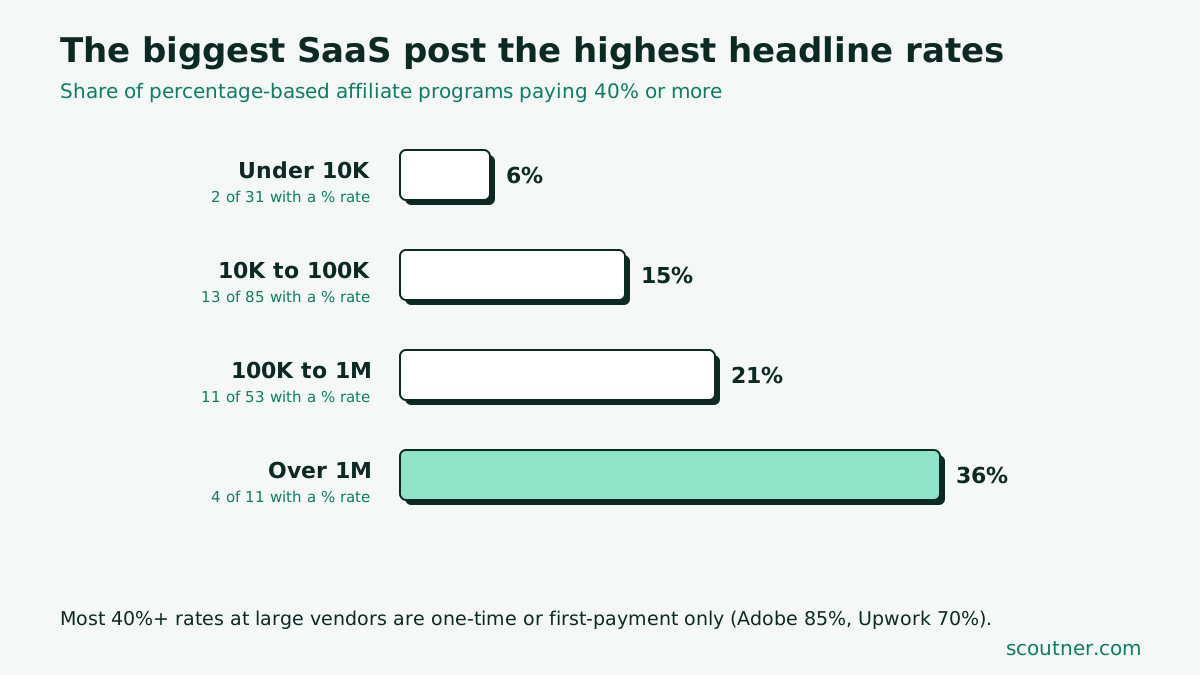
The high rates at large vendors are mostly one-off. Adobe pays 85% of the first month's subscription and Upwork 70% of the first contract spend, capped at $150. A large rate on a single payment can be worth less to an affiliate than 20% paid every month for years. The group above 1M visits is also the smallest, with 11 percentage programs, so its shares move a lot with each vendor.
Do small SaaS companies pay affiliates for longer?
Yes. Small vendors compete on duration, not rate. 29% of affiliate programs under 10K visits and 24% between 10K and 100K pay commission for the customer lifetime. Above 100K visits the share falls to 9%, and to 6% above 1M. Across all 231 affiliate programs, 43 pay for life.
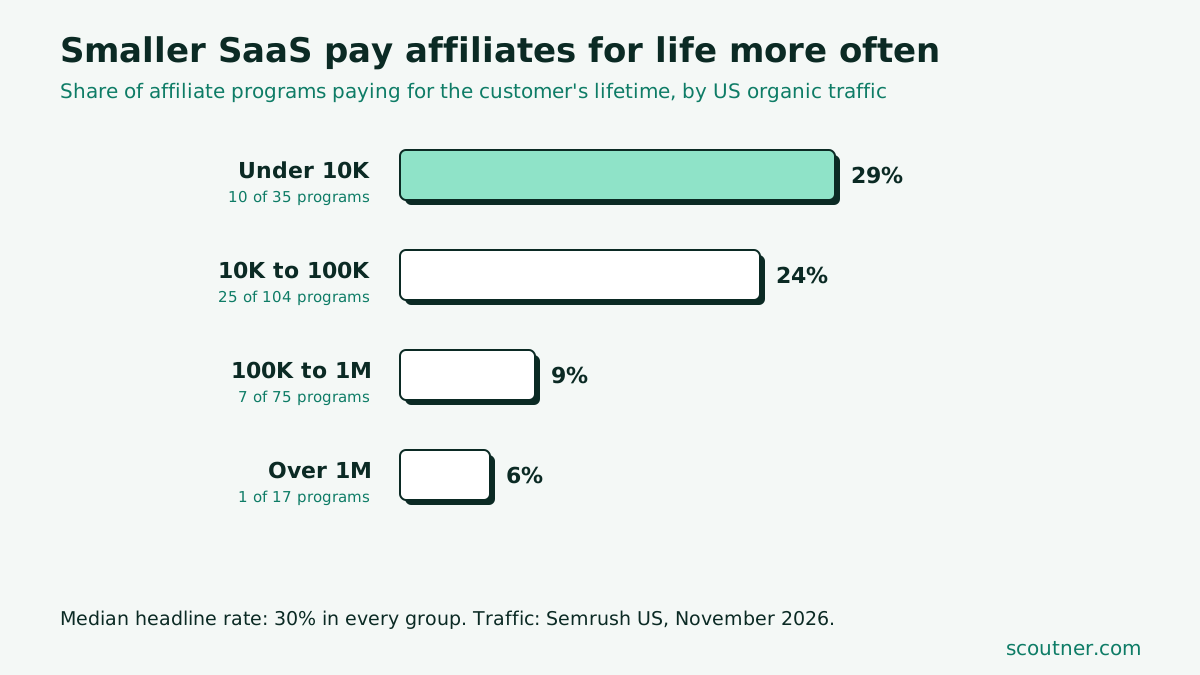
Pabbly, with about 6,000 monthly US organic visits, advertises a "30% Recurring Commission Forever" for as long as the customer stays active, with a 365-day cookie window. Woodpecker, at about 4,900 visits, pays 20% "every month for the customers you refer" with no cap or end date. At the other end, HubSpot pays 30% recurring for up to one year and Similarweb 50% for 12 months.
The logic is simple. A small vendor cannot promise an affiliate volume, so it promises that each customer keeps paying. A large vendor converts more of the traffic it receives and can cap the commission period without losing affiliates.
Which commission models do large SaaS companies prefer?
Large vendors pay flat bounties more and recurring commissions less. A flat amount per sale or signup is the model of 29% of affiliate programs above 1M visits, against 6% under 10K. Recurring commissions fall from 54% of programs under 10K visits to 35% above 1M.
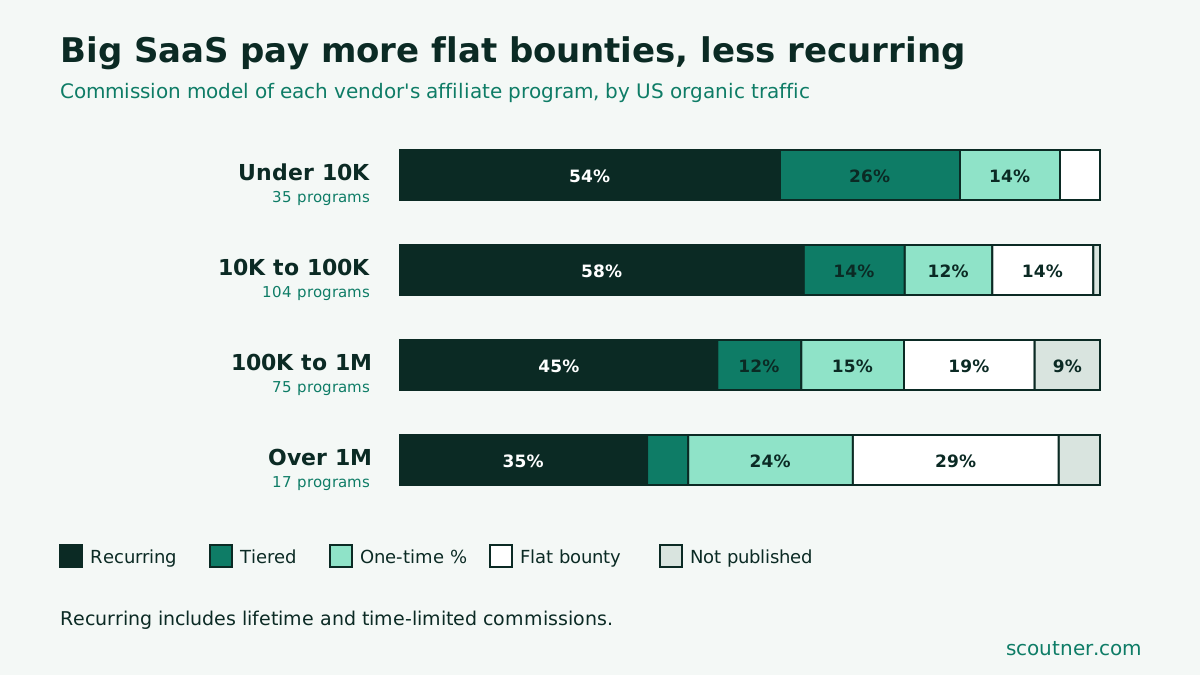
| Commission model | Under 10K | 10K to 100K | 100K to 1M | Over 1M |
|---|---|---|---|---|
| Recurring (lifetime or time-limited) | 54% | 58% | 45% | 35% |
| Tiered by volume | 26% | 14% | 12% | 6% |
| One-time percentage | 14% | 12% | 15% | 24% |
| Flat bounty | 6% | 14% | 19% | 29% |
| Lifetime commission (any model) | 29% | 24% | 9% | 6% |
| Affiliate programs | 35 | 104 | 75 | 17 |
Shopify pays "up to $150 USD per qualified referral", with the amount set by the referral's location. Semrush pays per sale by product and loyalty tier, from $100 to $300 in its headline and up to $450 in its table, plus $10 per free trial. Both read their sales in fixed amounts, which suits brands that many visitors already know.
Which affiliate platforms do SaaS companies use at each size?
The platform follows the size. Self-serve tools such as FirstPromoter, Reditus, Rewardful, Tolt and Dub run 34% of programs under 10K visits and none above 1M. Impact runs 6% of the smallest programs and 41% of the largest. PartnerStack leads the middle groups with about 30%.
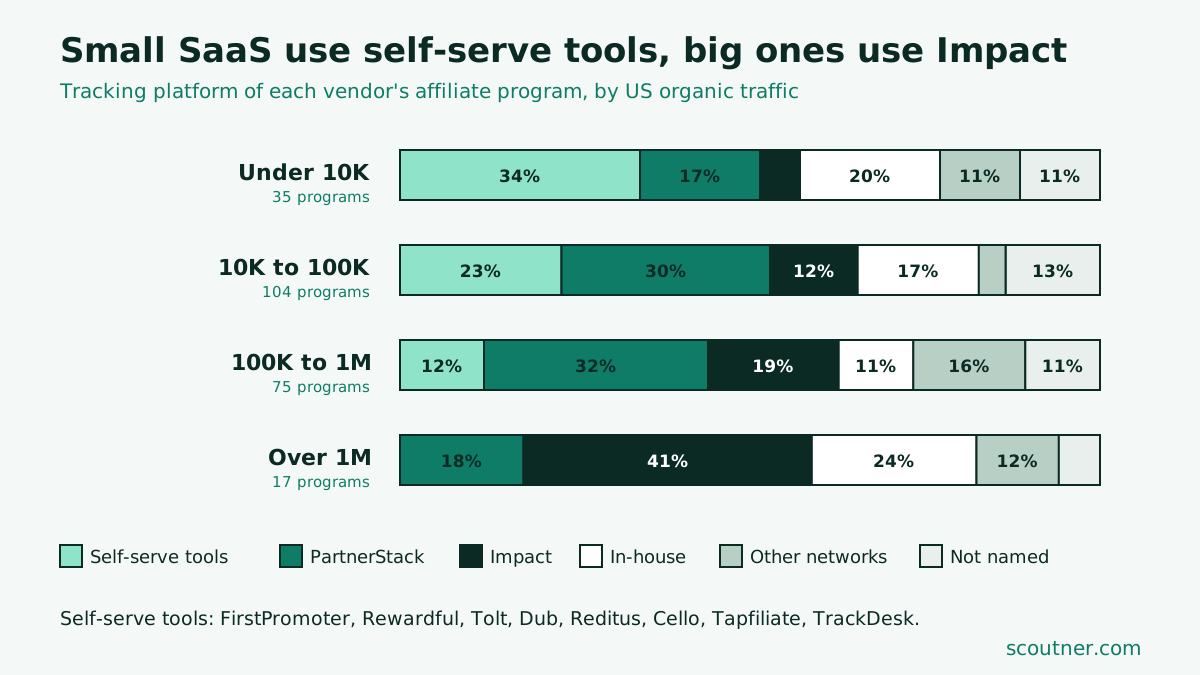
| Platform group | Under 10K | 10K to 100K | 100K to 1M | Over 1M |
|---|---|---|---|---|
| Self-serve tools (FirstPromoter, Reditus, Rewardful, Tolt, Dub, Cello, Tapfiliate, TrackDesk) | 34% | 23% | 12% | 0% |
| PartnerStack | 17% | 30% | 32% | 18% |
| Impact | 6% | 12% | 19% | 41% |
| In-house tracking | 20% | 17% | 11% | 24% |
| Other networks (Awin, CJ, Partnerize and others) | 11% | 4% | 16% | 12% |
| Not named on the program page | 11% | 13% | 11% | 6% |
Woodpecker's sign-up links point to Reditus, while Shopify and Semrush both say their programs are hosted on Impact. In-house tracking is common at both ends: Pabbly runs its own dashboard, and so do Zoho, NordVPN and remove.bg above 1M visits. For a cost comparison of the tools, see our PartnerStack alternatives and Rewardful alternatives pages.
Do large SaaS companies run more than one partner program?
Yes. 67% of vendors above 1M visits run more than one partner program, against 14% under 10K. A solutions, reseller or technology program, built for agencies, consultants and integration partners, exists at 39% of the largest vendors and 11% of vendors under 100K visits.
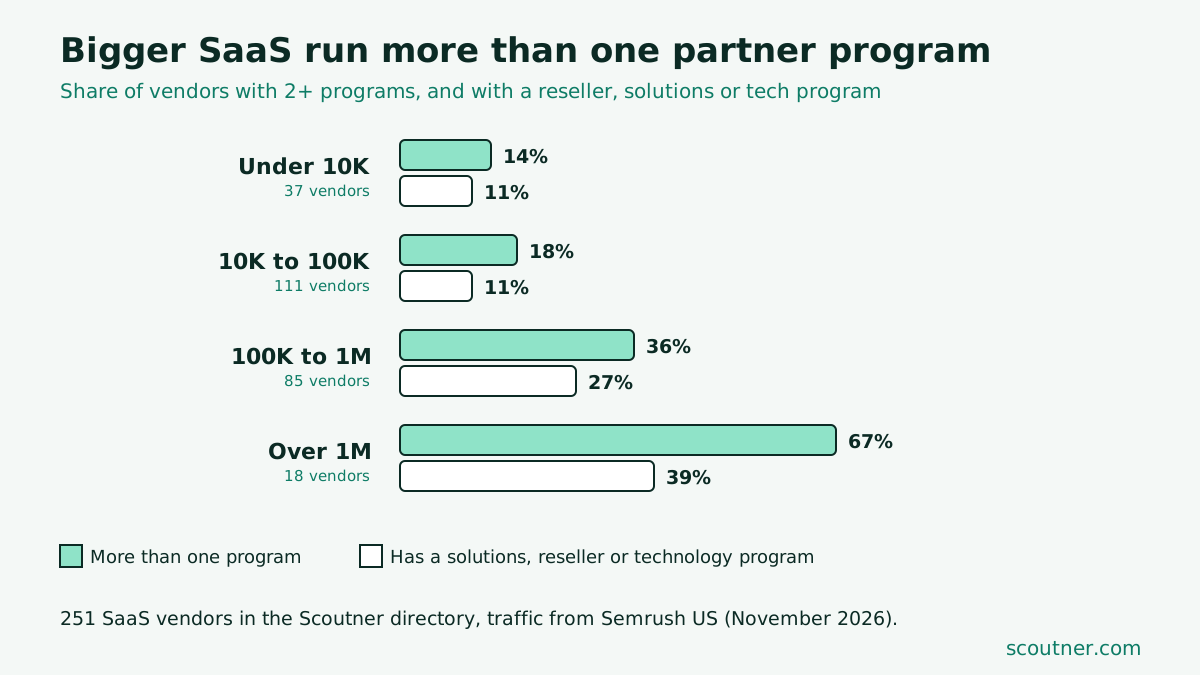
HubSpot runs an affiliate program next to its solutions partner program, Gusto has affiliate, referral and solutions programs, and Notion lists affiliate, reseller, solutions and technology partners. Smaller vendors usually start with affiliates alone because the program needs no partner team. Agencies and resellers come later, when a vendor can train and support them. Our guide to agency partner programs covers that second step.
What should a small SaaS company take from this?
Do not try to win on rate. The median is 30% at every size, so a higher number rarely stands out. Small vendors that compete for affiliates do it with duration: lifetime or multi-year recurring commissions, long cookie windows and a self-serve tool that lets anyone join in minutes.
Three practical points come out of the data:
- Sell the lifetime value, not the rate. 29% of the smallest programs pay for life. If your churn is low, a lifetime 20% can beat a large vendor's 12-month 30% for the affiliate.
- Pick a platform that matches your stage. Self-serve tools dominate below 10K visits for a reason: they are cheap to start. Move to a network when you need its marketplace of publishers, as most vendors above 1M visits have done.
- Plan the second program early. Two thirds of the largest vendors run more than one program. Our guide to finding channel partners shows how to pick the agencies and resellers that already sell to your customers.
For rates, cookies and platforms across the whole directory, see the SaaS Partner Program Benchmarks 2026. For the rules around commissions, see SaaS Affiliate Program Terms 2026.
How was this data collected?
The sample is every published vendor in the Scoutner directory on November 4, 2026: 255 SaaS vendors, of which 251 could be measured. Program terms were recorded from official program pages, terms and help centers between September 30 and October 5, 2026. Traffic was pulled from the Semrush US database on November 4, 2026.
- Size groups use Semrush's estimated monthly US organic search traffic for the vendor's main domain. It is an estimate of search reach, not revenue or employees.
- Each vendor counts once. When a vendor runs several affiliate programs, the first one listed in the directory is used for rate, model and platform.
- Commission model is the vendor's published model: recurring (lifetime or time-limited), tiered by volume, one-time percentage or flat bounty. Lifetime means the vendor says the commission is paid for as long as the customer pays.
- Rates are the headline percentage. The median uses the 180 programs that publish one with a recurring, tiered or one-time model.
- On November 4, 2026, the terms quoted for Pabbly, Woodpecker, Shopify and Semrush were re-read on their pages. Pabbly and Shopify matched. Woodpecker says "recurring" and "every month" without the word lifetime. Semrush's headline gives $100 to $300 per sale while its table goes up to $450; both are shown above.
- Vendors were selected by US search demand for "[brand] affiliate program", so the sample leans toward brands people already search for. Medians in the over 1M group rest on 17 programs.
How can you use this data?
The dataset and charts are free to use under the Creative Commons Attribution 4.0 license: cite "Scoutner SaaS Partner Programs by Company Size 2026" with a link to this page. The CSV has one row per vendor with its traffic, size group, program types, platform, commission model, rate, lifetime flag, duration, cookie window and the date its terms were checked.
Download: saas-partner-programs-by-company-size-2026.csv (255 vendors, 251 measured).
Embed a chart. Copy this code and change the file name to the chart you want (lifetime-by-size, high-rates-by-size, commission-model-by-size, platform-by-size or programs-by-size):
<a href="https://scoutner.com/reports/saas-partner-programs-by-company-size-2026"><img src="https://scoutner.com/reports/saas-partner-programs-by-company-size-2026/lifetime-by-size.svg" alt="Lifetime affiliate commissions by SaaS vendor size" width="1200" height="675"></a>
<p>Source: <a href="https://scoutner.com/reports/saas-partner-programs-by-company-size-2026">Scoutner SaaS Partner Programs by Company Size 2026</a></p>
Frequently asked questions
Do smaller SaaS companies pay higher affiliate commissions?
Not in rate. The median affiliate rate is 30% for SaaS vendors of every size in our sample of 251. Smaller vendors pay for longer instead: 29% of affiliate programs at vendors under 10K monthly US organic visits pay for the customer lifetime, against 6% above 1M visits.
Which SaaS affiliate programs pay lifetime commissions?
Mostly smaller vendors. 43 of 231 SaaS affiliate programs in our directory pay for the customer lifetime, and 35 of them belong to vendors under 100K monthly US organic visits. Pabbly, for example, pays 30% for as long as the referred customer stays active.
Which affiliate platform do large SaaS companies use?
Impact most often. It runs 7 of 17 affiliate programs at vendors above 1M monthly US organic visits, including Shopify, Semrush, HubSpot and Gusto. Self-serve tools like FirstPromoter and Reditus run 34% of programs under 10K visits and none of the largest.
How was company size measured in this study?
By estimated monthly US organic search traffic from Semrush, pulled on November 4, 2026, for each vendor main domain. It measures search reach, not revenue or employees. Vendors fall in four groups: under 10K visits, 10K to 100K, 100K to 1M and over 1M.
Can I reuse this data?
Yes. The dataset and the five charts are published under the Creative Commons Attribution 4.0 license. Cite Scoutner SaaS Partner Programs by Company Size 2026 with a link to the report page. The CSV lists every vendor, its traffic, size group, platform and commission terms.
Scoutner is an AI partner recruitment platform for B2B SaaS. The directory behind this report is the public part of its partner index.
Sources
- Scoutner SaaS affiliate and partner programs directory (255 vendors, sources listed on each program page), Scoutner, Checked September 30 to October 5, 2026
- Semrush Domain Overview, US database (estimated monthly organic traffic for 251 vendors), Semrush, Pulled November 4, 2026
- Pabbly Affiliate Program, Pabbly, Read November 4, 2026
- Woodpecker Referral Program, Woodpecker, Read November 4, 2026
- Shopify Affiliate Program, Shopify, Read November 4, 2026
- Semrush Affiliate Program, Semrush, Read November 4, 2026
 Shopify
 Moz
 Semrush
 HubSpot
 ClickUp
 Notion
 Airtable
 ClickFunnels
 HeyGen
 Fiverr
 Kinsta
 Squarespace
 systeme.io
 Teachable
 Thinkific
 Xero
 Framer
 HighLevel
 n8n
 QuickBooks
 1Password
 Adobe
 Bluehost
 Hostinger
 Lovable
 Mailchimp
 monday.com
 Skool
 ElevenLabs
 Grammarly
 Surfer
 Upwork
 Gusto
 Rippling
 ActiveCampaign
 Apollo.io
 Attio
 AWeber
 BambooHR
 beehiiv
 Bench
 Brevo
 Buffer
 Close
 Cloudways
 Deel
 Descript
 DreamHost
 Elementor
 folk
 Frase
 FreshBooks
 Freshworks
 GetResponse
 Hootsuite
 Instantly
 invideo
 Jotform
 Kajabi
 Keap
 Kit
 Kittl
 Later
 LearnWorlds
 lemlist
 Lusha
 MailerLite
 Make
 Mangools
 Metricool
 Miro
 Murf AI
 Namecheap
 NordPass
 OnPay
 Originality.ai
 Pabbly
 Piktochart
 Pipedrive
 Podia
 Proton
 Reply.io
 Riverside
 Rytr
 SE Ranking
 SiteGround
 Smartlead
 SocialBee
 Softr
 Sprout Social
 Synthesia
 Tally
 ThriveCart
 Typeform
 VEED
 Visme
 Webflow
 Woodpecker
 WP Engine
 Writesonic
 Zoho