
Most partner programs do not fail at recruiting. They fail in the weeks after a partner signs. The partner gets a login, a link and a welcome email, then nothing that helps them bring your product up with a client. Three months later, they are one more inactive name in the dashboard.
Partner enablement is the work that closes that gap. Most guides on the topic are written for large channel teams with a partner relationship management (PRM) tool and a budget for certifications. This one is written for a B2B SaaS with 10 to 100 partners: what to give them, in what order, and what two well-run programs, HubSpot and Webflow, actually ask of their partners.
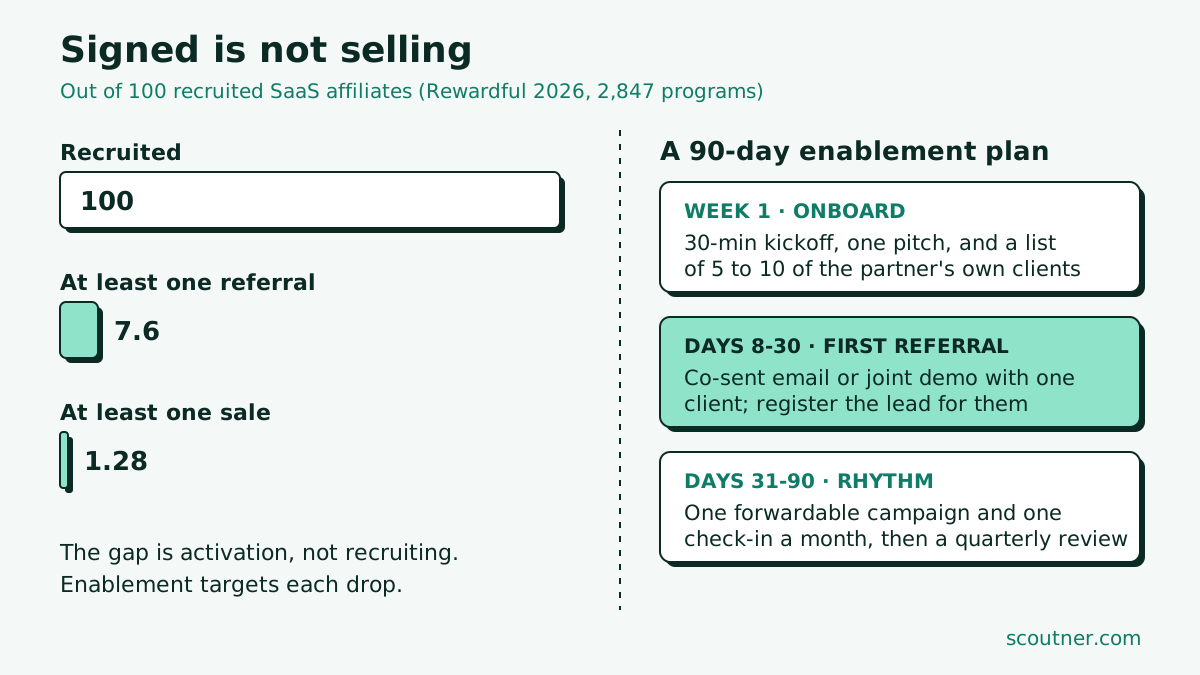
- Only 7.6% of affiliates generate a referral and 1.28% a sale, across 2,847 SaaS programs (Rewardful, 2026). Activation, not sign-ups, is the bottleneck.
- Partner enablement covers six things: training, a pitch per partner type, ready-to-forward assets, a demo account, deal registration, and a monthly rhythm.
- HubSpot requires a partner certification and gives every Solutions Partner an Enterprise demo account; Webflow asks for a skills assessment and three client sites before it certifies an agency.
- A Forrester study commissioned by Microsoft (December 2025) modeled a 10% yearly win-rate gain for partners who complete training. Treat it as a vendor-funded estimate.
- Measure enablement by time to first referral and the share of partners active each quarter.
What is partner enablement?
Partner enablement is the set of training, tools and support a company gives its partners so they can promote, sell and support its product on their own. It runs from onboarding (what the product does, who it is for) to selling (pitch, assets, demo account, deal registration) to a monthly rhythm that keeps partners talking to their clients about you.
PartnerStack's glossary defines it as activities and resources that equip channel partners with "the knowledge, skills and tools" to promote, sell and support a product. Impartner compares it to sales enablement, applied to people who do not work for you. That difference is the whole difficulty. Your sales team has to listen to you; a partner sells for several vendors and gives attention to whoever makes their job easiest.
For a B2B SaaS, partners fall into a few groups, and each needs a different level of enablement. An affiliate who writes reviews needs accurate data and screenshots. An agency that implements your product needs training and a sandbox. A reseller needs pricing, contracts and support paths. If you are unsure which group a partner belongs to, see affiliate vs referral partner vs reseller.
Why does partner enablement matter for a B2B SaaS?
Because most partners who sign never sell. Rewardful's 2026 report on 2,847 active SaaS affiliate programs found that 7.6% of affiliates generate at least one referral and 1.28% generate at least one sale. The commission is rarely the problem. Partners stall because they do not know who to pitch, what to say, or what to send.
The same report shows that 56% of programs run with fewer than 50 affiliates. With programs that small, every inactive partner is a large share of your capacity.
Larger companies see the same blockers. In PartnerStack and Wynter's State of Partnerships in GTM 2026 survey of 100 senior leaders at B2B SaaS companies with $50M+ in revenue, the biggest obstacles to partner revenue were alignment between teams (37%), no clear partner program (20%) and lack of visibility into partner impact (14%). All three are enablement problems: partners and your own team do not share a plan.
There is also evidence that training pays when partners complete it. A Forrester Total Economic Impact study commissioned by Microsoft (December 2025) modeled a composite partner organization and found a 10% yearly improvement in win rate and a 217% ROI on its skilling and enablement program. Interviewed partners estimated a 5% to 10% win-rate increase from certifications. It is a vendor-funded model, not an industry average, but it points the same way as the activation data.
What should a partner enablement kit include?
A partner enablement kit has six parts: a short training on who buys and why, a pitch for each partner type, assets partners can forward as they are, a demo or sandbox account, a simple way to register deals or leads, and a contact who answers within a day. Start with the pitch and the demo account; they unlock the first referral.
| Component | What it contains | Who needs it most | Minimum version for a small program |
|---|---|---|---|
| Training | Who your buyer is, the 3 problems you solve, when not to recommend you | Agencies, resellers | A 20-minute recorded walkthrough and a one-page FAQ |
| Pitch | The client situations where your product fits, one-line value, objections | Referral partners, agencies | One pitch per partner type, under 150 words |
| Assets | One-pager, email, LinkedIn or newsletter blurb, screenshots, case study | Affiliates, referral partners | Co-brandable one-pager plus one email they forward as is |
| Demo account | A sandbox with sample data that partners can show clients | Agencies, integrators | A shared demo workspace reset monthly |
| Deal registration | A form or link to log a lead and protect the partner's credit | Referral partners, resellers | A form that writes to your CRM, with a reply within 48 hours |
| Support | A named contact, office hours, a channel | Everyone | One email address and a monthly 30-minute call |
The order matters. Partners judge your program in their first two weeks. If the first thing they receive is a 40-page partner guide, it goes unread. If they receive a pitch, a forwardable email and a list of their own clients who fit, they can act the same week.
What do HubSpot and Webflow require from partners?
Both tie benefits to proof of skill. HubSpot asks every Solutions Partner to pass a partner certification and pay for a $400 per month package, then gives them an Enterprise demo account and training. Webflow asks agencies to pass a skills assessment and ship three client sites before certification, which unlocks a 20% commission and a sandbox.
Both programs are in our directory with their full terms: HubSpot and Webflow. Gusto, which works with accountants, takes a lighter route: free certification courses with CPE credits, a dedicated account representative, a directory listing it says is viewed by 500,000+ small businesses, and up to 20% revenue share (Gusto).
How do you build a 90-day partner enablement plan?
Split the first 90 days into three stages. In week one, onboard: a short training, the pitch and a list of the partner's own clients who fit. From day 8 to day 30, aim for one referral: a joint call or a co-sent email to one client. From day 31 to day 90, set a monthly rhythm: one campaign to forward, one check-in, one quarterly review.
Week 1: onboarding. Run a 30-minute kickoff, not a self-serve course. Cover who buys, the three situations where your product wins, and when the partner should not recommend you. End the call with a short list of five to ten of the partner's own clients who look like your best customers. That list does more for activation than any training module.
Days 8 to 30: the first referral. Pick one client from the list and help the partner start the conversation: a co-written email, a joint demo, or a short case study they can forward. Register the lead for them if they hesitate. The goal is a first referral inside 30 days, because partners who see a result early keep going.
Days 31 to 90: a monthly rhythm. Each month, send one thing a partner can forward as is (a new feature with a client angle, a benchmark, a webinar invite) and hold one short check-in. At day 90, review together: referrals sent, deals won, what clients asked. Agree on the next three accounts.
Speed matters at the start. PartnerStack's Research Lab (June 2024) found that the median partner in its network joins a first partnership two days after approval, and 37% within 24 hours. Partners are motivated right after they sign; that is when your kickoff call should happen, not three weeks later.
How do you measure partner enablement?
Measure enablement by behavior, not by content produced. Track four numbers: time from signing to first referral, the share of partners with at least one referral each quarter, the share who completed onboarding, and partner-sourced revenue per active partner. If onboarding completion is high but referrals stay flat, the pitch or the target list is wrong, not the training.
| Metric | How to calculate it | Why it matters |
|---|---|---|
| Time to first referral | Days from signed agreement to first registered lead | Shows if onboarding leads to action |
| Active partner rate | Partners with 1+ referral in the quarter / all partners | The real size of your program |
| Onboarding completion | Partners who attended kickoff and got a client list / all signed | Separates enablement gaps from fit gaps |
| Revenue per active partner | Partner-sourced revenue / active partners | Tells you where to invest more time |
Compare these numbers by partner type. Our page on how to measure partner program ROI covers the revenue side, and how to improve channel partner engagement covers what to do with partners who go quiet.
What partner enablement mistakes should you avoid?
The most common mistake is enabling the wrong partners: no training rescues a partner whose clients will never buy your product. The next ones are a long portal nobody reads, generic assets that partners must rewrite before using, and no follow-up after onboarding. Each turns a signed partner into an inactive one within a quarter.
Four checks before you invest more in enablement:
- Fit first. If partners do not serve your buyers, enablement will not help. Re-read how to find channel partners and score your list again.
- One pitch per partner type. An affiliate and an implementation agency should not get the same deck.
- Forwardable, not editable. Partners use assets they can send in under a minute.
- A named person. Partners stay with programs where someone answers quickly. HubSpot assigns a Partner Development Manager; Gusto assigns an account representative.
Frequently asked questions
What is partner enablement?
Partner enablement is the training, tools and support a company gives its partners so they can promote, sell and support its product on their own: onboarding, a pitch per partner type, forwardable assets, a demo account, deal registration and a monthly rhythm.
What is the difference between partner enablement and partner onboarding?
Onboarding is the first stage of enablement: the kickoff, training and first account list in a partner's first weeks. Enablement continues after that with assets, demo accounts, deal registration and a monthly check-in that keep partners selling.
What should a partner enablement program include?
Six components: short training on who buys and why, one pitch per partner type, assets partners can forward as they are, a demo or sandbox account, a deal registration form, and a named contact who answers within a day.
How do you measure partner enablement success?
Track time from signing to first referral, the share of partners with at least one referral per quarter, onboarding completion, and partner-sourced revenue per active partner. Rewardful found that only 7.6% of SaaS affiliates ever send a referral, so the active partner rate is the key number.
Scoutner is an AI partner recruitment platform for B2B SaaS. It finds the agencies, consultants and creators that already serve your customers, so the partners you enable are the ones whose clients can buy.
Sources
- State of SaaS Affiliate Programs Report, 2026 Edition, Rewardful, Updated July 21, 2026
- The State of Partnerships in GTM 2026 (press release), PartnerStack and Wynter, September 29, 2025
- The Total Economic Impact of the Microsoft Skilling and Enablement Program, Forrester Consulting, commissioned by Microsoft, December 2025
- Most network partners have a median time of 2 days to joining their first partnership, PartnerStack Research Lab, June 2024
- 2026 entry and tiers policy for HubSpot Solutions Partners, HubSpot, Checked October 9, 2026
- Solutions Partner tiers and benefits 2026, HubSpot, Checked October 9, 2026
- How tiers work, HubSpot, Updated April 10, 2026
- Webflow Certified Partner Program: apply, Webflow, Checked October 9, 2026
- Gusto Partner Program for Accountants, Gusto, August 12, 2026
- Partner enablement (glossary), PartnerStack, Checked October 9, 2026
Related articles
For SaaS founders
Building your partner channel? See which agencies could sell your SaaSPaste your website. Scout scores 10 partners (agencies, consultants, resellers) who already sell to your buyers, with decision-makers. Free. Shopify
 Moz
 Semrush
 HubSpot
 ClickUp
 Notion
 Airtable
 ClickFunnels
 HeyGen
 Fiverr
 Kinsta
 Squarespace
 systeme.io
 Teachable
 Thinkific
 Xero
 Framer
 HighLevel
 n8n
 QuickBooks
 1Password
 Adobe
 Bluehost
 Hostinger
 Lovable
 Mailchimp
 monday.com
 Skool
 ElevenLabs
 Grammarly
 Surfer
 Upwork
 Gusto
 Rippling
 ActiveCampaign
 Apollo.io
 Attio
 AWeber
 BambooHR
 beehiiv
 Bench
 Brevo
 Buffer
 Close
 Cloudways
 Deel
 Descript
 DreamHost
 Elementor
 folk
 Frase
 FreshBooks
 Freshworks
 GetResponse
 Hootsuite
 Instantly
 invideo
 Jotform
 Kajabi
 Keap
 Kit
 Kittl
 Later
 LearnWorlds
 lemlist
 Lusha
 MailerLite
 Make
 Mangools
 Metricool
 Miro
 Murf AI
 Namecheap
 NordPass
 OnPay
 Originality.ai
 Pabbly
 Piktochart
 Pipedrive
 Podia
 Proton
 Reply.io
 Riverside
 Rytr
 SE Ranking
 SiteGround
 Smartlead
 SocialBee
 Softr
 Sprout Social
 Synthesia
 Tally
 ThriveCart
 Typeform
 VEED
 Visme
 Webflow
 Woodpecker
 WP Engine
 Writesonic
 Zoho